Experienced AI agency for the development of customised AI software solutions
As a leading AI agency, we support large and medium-sized companies in the question of whether and how they can benefit from AI. To this end, we analyse your existing processes and systems to identify potential and develop new AI solutions. In doing so, we rely on technological expertise, iterative development and a wealth of experience.














What is (still) holding back your first AI project?
You have the desire to innovate, but your current internal processes, methods and mindset are holding you back. Then you are probably familiar with one of the following barriers.

Lack of strategy
You know that trial and error can be an expensive process. But you don’t know where to start integrating AI to get the most out of it? Preventing artificial intelligence from becoming a money pit requires a strategic plan for your AI journey.

Lack of AI expertise
Effective AI systems require reliable data. Many of our customers need to improve here. Do you? Often there is a lack of data scientists and AI experts within the organisation who can confidently drive data and regulatory compliant AI system development.

Lack of trust in AI
AI won’t reach its full potential unless your people use it properly. Your organisation needs to proactively manage change by providing transparent information about reliability, GDPR compliance and data security to reduce internal scepticism.

High cost pressure
Working with limited budgets, you often need to deliver results to build internal support for further AI initiatives. Is custom development worthwhile, or can off-the-shelf AI software be used to leapfrog? The implications of these decisions are huge.
Customised AI solutions are our speciality as an AI agency
Artificial intelligence can be a driver of added value in any company. If you know how. As an AI agency, we are your full-service partner for all aspects of your project.
Need a specialised solution? If so, we will use an iterative methodology to develop your custom AI system, starting with a minimum viable product. Based on user feedback, we then provide you with data-driven support to further develop and optimise the application.
You already have an idea for an AI use case: we then develop an initial prototype in agile innovation sprints that demonstrates the potential for your use case and the necessary preconditions. The result: We gain a deep understanding of your ideal AI solution.
Need a specialised solution? We use an iterative methodology to develop your bespoke AI system, starting with a minimum viable product. Based on user feedback, we then provide you with data-driven support to further develop and optimise the application.
Here are the 8 most common use cases for artificial intelligence
As an AI agency, we integrate artificial intelligence into a wide range of business areas. Let us inspire you on how you too can put technology to work for you.
.svg)
The most lucrative use case for AI is in the automation of processes. Not only can AI systems take over your basic tasks, but they can also read your documents, pick your goods, make forecasts and carry out many other activities in a matter of seconds.

AI-powered chatbots are revolutionising customer service by engaging in human-like conversations with your customers, often allowing them to resolve their own issues. On average, AI chatbots can reduce your call and ticket volume by more than 20%.
.svg)
You can also use AI to mitigate various risks. Using AI data analytics, you can merge data from different sources and process it efficiently. This allows you to identify positive and negative trends early and, most importantly, make informed decisions.
.svg)
With the help of AI, you can intelligently process and use valuable customer behaviour data. This forms the basis for addressing your customers at the right time with personalised content, making them individual offers and significantly increasing your sales quota.

Use Chat-GPT’s AI model as a strong basis for your customised corporate AI. As an AI agency, we train the custom GPT version with your data, customise the application to your specific needs and ensure that it is used in compliance with data protection regulations.

Personal recommendations aren’t just for Amazon and Netflix to increase loyalty and sales. Using AI algorithms, your business can also benefit from intelligent recommendations to increase up-sell and cross-sell offers.

Extend the service life of your machines, avoid costly production downtimes and shorten repair times. Artificial intelligence can monitor the function of your machines and significantly increase downtime in your plants.

Improve your company’s protection against serious attacks and attempted fraud. Advanced AI algorithms recognise rule violations and irregularities in digital usage patterns in real time and can immediately trigger protective measures for you.
Considering the potential AI could unlock for your business?
Our tried-and-tested approach as an AI agency for your successful project
As an AI agency, we guide you with proven methodology from the idea to the go-live of your AI system. With the right balance of structure and flexibility. Take advantage of our 17 years of transformation experience and give your processes an upgrade with trustworthy, customised AI.




Ambitious requirements are
our passion as an
AI agency
We utilise various AI technologies and adapt their use to your specific requirements and existing IT infrastructure. As an AI agency, we also offer consulting services for the optimal hosting option, be it via large cloud providers such as AWS or Azure, hosting on our own servers or with smaller providers.





5 reasons why SPRYLAB is exactly the AI agency you are looking for
Whether your goal is increased efficiency, sales growth or AI-driven innovation, we can guarantee you a successful project with our expertise and experience in AI development. We will implement it on time, within budget and with the highest quality.
We have built up in-depth expertise in over 15 AI projects. Our own SaaS product with integrated AI modules also serves as a field for innovation and experimentation.
AI innovation and preferably immediately? We manage the balancing act between quality and speed in AI development. Thanks to agile methods and our customised best practices.
In 16 years of software development, we have always delivered the results we promised – 83% of our new projects come from recommendations.
After a total of more than 150 customer projects, we know what causes software projects to fail and reliably ensure that your project is a success story.
High-performance AI systems are always created as a team. We advise you honestly and as equals – and, if necessary, speak uncomfortable truths directly.
Over 15 AI projects
successfully completed
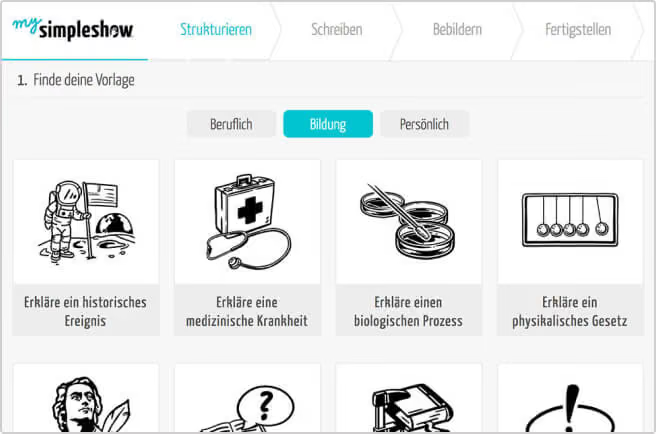

AI-powered video platform
The platform allows customers to create professional explainer videos themselves using an intelligent workflow. We had the pleasure of supporting its further development for nearly three years.


Placement platform
Creation of a nationwide information, consulting, and placement portal, including an AI chatbot for care services, for Germany's largest ecumenical start-up.
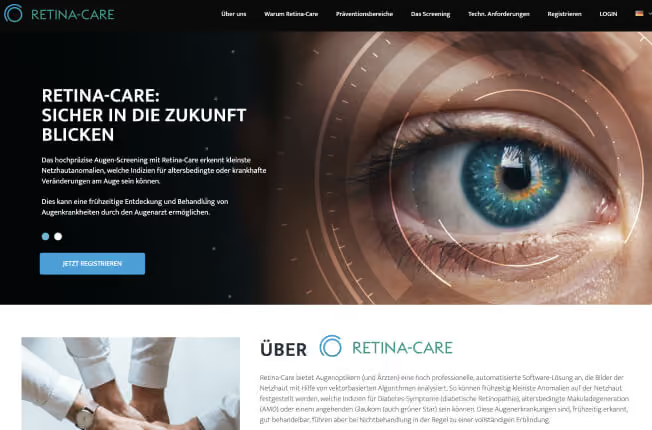
Retina care platform
The platform offers high-precision eye screening based on AI-driven software. The solution analyzes retinal images using vector-based algorithms in under a minute.


AI-powered SaaS product
Conceptualization and development of digital publishing software with integrated AI features. Purple DS counts numerous international publishers among its clients.


Digital AI training
Together with SPRYLAB, Coachinho refined its business model and launched an initial MVP version of its app internationally in just under three months.
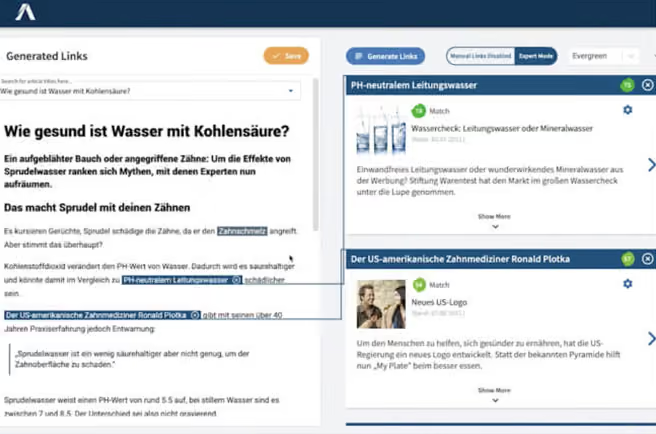

Integrated AI module
Seamless integration of the automated internal linking feature powered by artificial intelligence. This function is part of Purple's integrated content intelligence module.
What our clients say about us as an AI agency

at Ringier
“We have been working successfully with SPRYLAB for many years. The team always thinks along with us and provides great impulses. They also work at breathtaking speed!”

“SPRYLAB implemented our self-service portal extremely quickly and professionally. Keyword great service: The team is very agile and so even unforeseeable, sudden requirements were no problem.”

“In SPRYLAB we found an absolutely competent service provider for developing our platform. We were very impressed by their professional approach to consulting and the fast and reliable implementation of the platform.”
Would you like to turn your digital idea into reality? Talk to us!
We are driven by exciting and challenging projects. If you are looking for an AI agency to grow with, we are the right partner for you.

Book a free consultation
FAQs about SPRYLAB as an AI agency
We cannot give a generalised answer to this question. It is true that many AI systems require a large amount of high-quality data in order to produce reliable results. However, this does not mean that you have to wait until you have expanded or improved the quality of your database. Depending on the planned use case for the AI, you have alternative options for training your algorithm that require little or no data of your own. Buzzwords here include "few-shot learning" and "zero-shot learning". As an AI agency, we will be happy to advise you individually on which methodology is best suited to your case.
Very good question. With AI projects, you should define clear, measurable goals in advance in order to be able to objectively demonstrate the success of the introduction. The specific KPIs naturally depend on your particular use case. You should differentiate between quantitative and qualitative metrics. Examples of quantitative metrics: Throughput time of a process, error rate, use of resources, costs, accuracy of predictions.
To calculate the ROI, compare the total costs of AI implementation, including employee training and maintenance, with the cost savings or financial gain made possible by the use of AI. Again, examples of qualitative metrics: Employee satisfaction, improved user experience in work processes, organisation's ability to innovate. It is best to survey the status quo of the qualitative metrics before introducing AI in order to be able to determine changes after three and six months via a new survey.
There are also many areas of application for artificial intelligence in which you do not have to comply with data protection regulations because no personal data is processed. For example, you can use AI to monitor the wear and tear on parts of your production machines or to minimise waste in manufacturing processes. You do not have to observe any data protection regulations here. What must always be ensured, however, is the security of the processed data.
If you use personal data for your AI systems, you must ensure that your company still complies with the legislation, especially the GDPR. This can lead to major technical challenges if your users request the deletion of their data, for example. Because once data has been fed into an AI, it cannot be easily removed from the data model. To avoid any nasty surprises here, seek individual advice on data protection and data security from us or another AI agency in the run-up to the introduction of AI.
As an AI agency, we are often confronted with this question. Of course, the introduction of artificial intelligence not only changes some work processes, but is also a highly emotional topic for all employees.
The announcement that AI will be increasingly integrated into the organisation in the future may trigger enthusiasm in some, but can also fuel fear in others, e.g. of losing their job in the near future. However, in our experience as an AI agency, this is not a realistic scenario in most cases: instead, the responsibilities and tasks of employees will often change. As an employer, you can support your employees by offering training so that they can successfully master the changed way of working with AI. If some jobs do become redundant due to AI, you should offer the affected employees retraining opportunities in good time. There will often be other areas of the company where your employees' skills and qualifications can still be utilised.
We take a proactive approach to the development of our AI models. As an AI agency, we have always focussed on transparency and document our process comprehensively. By working closely with our customers, we are able to identify risks of bias and errors at an early stage, both at a technical and process level, and integrate suitable protective measures into systems and workflows.
In our experience, a well thought-out strategy is essential if you want to utilise the potential of artificial intelligence. The strategy does not have to be oversized: it is sufficient to start by working with a small core group to consider how AI will change your business model and in which areas it can deliver significant added value. In this way, you can quickly identify potential applications for AI that are not only possible but also make strategic sense.
Many AI use cases are challenging in terms of technical implementation. They require a broad database and adjustments to the data infrastructure. It can take months before a measurable benefit is realised. To gain internal support for more use of AI, you need to be able to deliver initial results quickly and demonstrate a positive return on investment. Choose your first AI use case accordingly: Start with a manageable project that is feasible and contributes to your company's strategic goals.
Artificial intelligence has so many different forms and applications that there are probably use cases for a sensible use of AI in your company too. Small companies with a limited budget may not be able to afford customised AI development, but they can significantly simplify their day-to-day work with off-the-shelf AI applications. Use the expertise of external partners at the beginning before you spend time building up your own team. As an AI agency, analysing AI opportunities is part of our daily business.
It is important to use artificial intelligence strategically: Just because a chatbot can be quickly integrated into your process with the help of an AI agency does not mean that the investment is worthwhile in your specific case and that the added value is in proportion to your costs. Start with your goals and then check whether and how you can achieve them faster or more cost-effectively with the help of artificial intelligence.
Artificial intelligence describes digital applications that can perform tasks that normally require human intelligence, such as understanding language, making decisions or learning from experience. For this purpose, algorithms are developed that no longer give the computer fixed instructions for action, but instead set it a target. The AI algorithm then finds its own way to the solution based on data, can evaluate its result and gradually improve it.
Generative AI is a subcategory of artificial intelligence that generates content - in text, images, sound or video. The best-known application is probably ChatGPT, which has rapidly popularised AI among the general public. ChatGPT has been pre-trained on a huge database so that the application is able to chat with users via text chat in natural language, for example to answer questions, explain information or analyse files. Generative AI models can be used by companies in many areas, for example to optimise data analysis, automate customer support, make employee training more cost-efficient and accelerate content creation for marketing and sales.