From HPI Connect to a dream job as a working student in software development

Eighteen months ago, Fabian Georgi first became aware of SPRYLAB at the HPI Connect fair. In this interview he gives you insights into his path as a student so far, from his bachelor's degree in applied computer science at the University of Applied Sciences Berlin (HTW) through to his master's in IT systems engineering at the Hasso Plattner Institute (HPI). He also tells you :
- why he specifically chose to do a master's at the HPI,
- which projects and professors inspired him most there,
- what he has learned in five years of working as a working student in software development
1 Can you introduce yourself briefly and tell us what you are studying?
I am Fabian Georgi, 24 years old and I live in Berlin. I did my bachelor's in applied computer science at HTW Berlin. The degree focused on custom software development, working in teams and effective project management. After my bachelor's I moved to the HPI in April 2021, during the Corona pandemic. I am doing a master's in IT systems engineering there and am currently deep into writing my master's thesis. Alongside that I have been working at SPRYLAB as a working student for eighteen months. In my free time I like to run and have completed a few half marathons and marathons, including the one in 2022 when Eliud Kipchoge set a new world record in Berlin.
2 Why did you decide to do a master's at the HPI?
To be honest, I had already applied to the HPI for my bachelor's, but the competition was too strong back then and I was rejected with a grade point average of 1.3. The application is somewhat more extensive and takes into account not only your final school grade but also a letter of motivation and extracurricular activities. The HPI is known for looking for excellence, and back then I probably could not show enough relevant activities and experience alongside school. So I decided on HTW Berlin, because they also offer a very hands-on degree. I have never regretted that decision. I got a top education there and met a lot of interesting people, including many lecturers from industry.
For the master's I tried the HPI again, and this time it worked out. Three years ago that was the perfect transition for me: many of my fellow students went straight into working life after their bachelor's, but I wanted to do the master's immediately afterwards. When I started there were four master's programmes at the HPI: IT systems engineering, data engineering, cybersecurity and digital health. I then decided on the classic IT systems engineering programme, because it is very broad and gives us students a lot of freedom. Since I did not yet know exactly where I wanted to end up, that was the best choice for me.
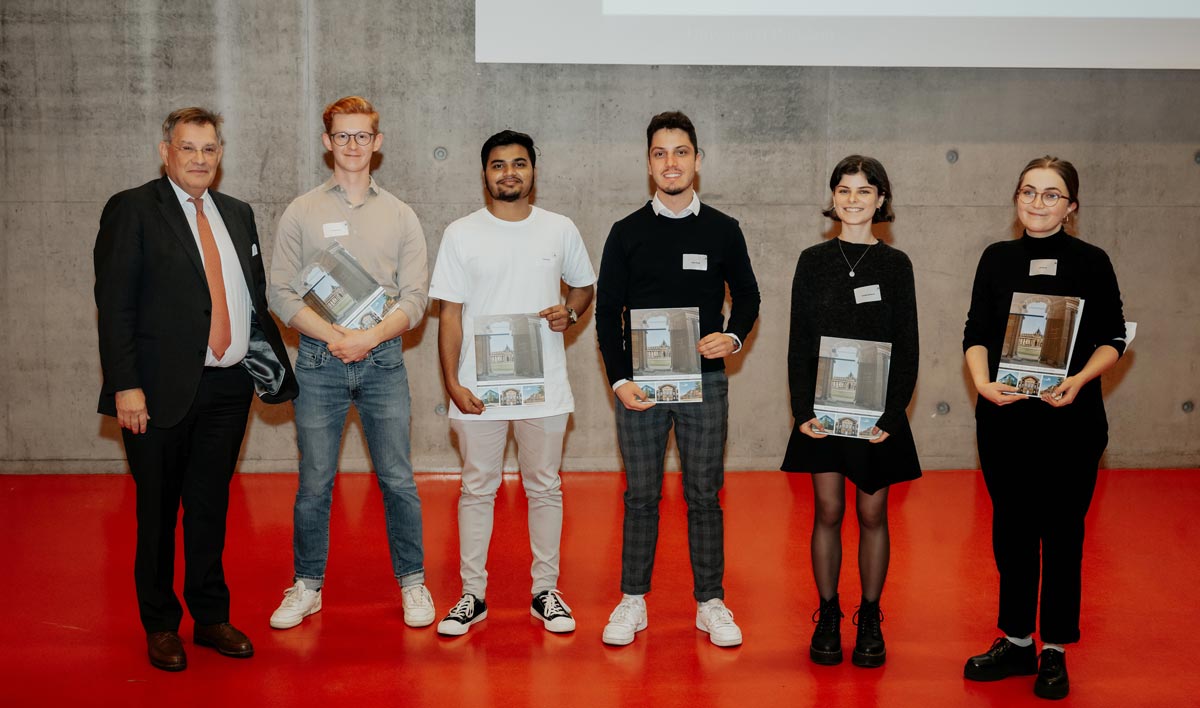
3 Are there particular professors or lecturers who inspired you most?
I find most professors at the HPI very inspiring, because they are real experts in their field and their extensive knowledge impresses me again and again. Even so, I would like to highlight two professors in particular.
First, Prof Dr Christian Dörr, who heads the cybersecurity and enterprise security group. I took his course in cyber security management. It is actually a very dry topic, since it focuses on management and legal aspects of cyber security, but Prof Dörr has a remarkable talent for teaching and makes even subjects like that engaging and vivid, which is why I sometimes still listen to selected talks of his in my own time.
Second, Prof Dr Tilmann Rabl and his research area of data engineering systems. He teaches how to process large volumes of data efficiently. I took many of his courses, including my master's project, because I find his approaches extremely interesting.
Quite apart from the professors, the HPI also places great value on soft skills as part of the degree, because complex software can only be developed in a team. There are many courses that look at interpersonal aspects, for example, such as communication in conflict, group dynamics and motivation. These intensive courses, often with external experts, have had a lasting effect on my outlook on life and on the way I think.
4 Can you tell us about a particularly interesting or challenging project you worked on during your studies?
Two projects come to mind. The first was my master's project with Prof Rabl in data engineering systems. Master's projects at the HPI are intensive hands-on research projects in small teams of three to six students, supervised over a whole semester. You have weekly meetings with the professor and are additionally supported and advised by PhD students.
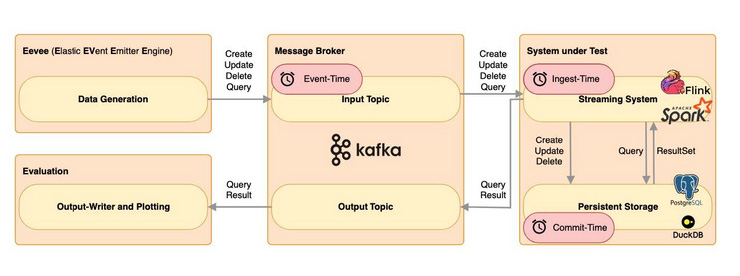
Our project dealt with developing a real-time analytics benchmark. The goal was to develop a benchmark that can analyse the real-time data processing of different systems. Traditional benchmarks focus either on the speed of query processing or on the latency of data ingestion and the freshness of the data. We combined these two aspects in a single benchmark in order to assess system performance more fully. We measure how fast the system can take in the data and how well it scales under load. At the same time we check whether the system still delivers fast responses and how current the data is. That was a novel approach that allows systems to be examined in a more complex and more holistic way. This project was not only technically demanding but also very instructive, because it required hands-on research and teamwork.
Another interesting project was even more accessible and more hands-on. I did it together with a fellow student as part of Prof Felix Naumann's information integration lecture. It was about combining different data sources in order to gain new insights. Specifically, we crawled commercial register announcements and historical share prices of companies and merged those datasets. The commercial register announcements were only available as unstructured text, which made parsing and structuring the data an interesting challenge. We investigated how certain events, such as changes on the management board, influence the share price. I thought this project was great, because the combined data let us see new connections that would not have been visible in the individual datasets. My project partner and I even won the internal HPI competition with it, against 24 projects.
5 How did you become aware of SPRYLAB, and what made you apply to us 18 months ago?
I first heard about SPRYLAB at the HPI Connect fair. The HPI runs HPI Connect every year, where companies have the chance to rent a stand in the institute's main building. Students can meet potential employers there to see whether they are a good fit. At HPI Connect you also get information about companies in personal conversations that you would not get from the outside.
SPRYLAB was at one of the HPI Connect fairs and I got to meet Arthur Silber and Yannis Kommana from the team. I still remember exactly what my first impression was: "Wow, they are seriously likeable." After I had seen all the stands, I went back to SPRYLAB's stand to exchange contact details. After a few short emails I was already in the coding interview, and shortly after that I had an employment contract on the table. The fact that Arthur and Yannis studied at the HPI a few years before me was not the deciding factor, but it did not hurt either.
6 What did you learn in five years as a working student at Adesso and SPRYLAB that you do not learn on a computer science degree?
Work and studying sometimes feel like two different disciplines to me. On the one hand, a degree teaches you the fundamental principles of how computers work and how software is developed, but of course many topics naturally stay theoretical. As a working student at Adesso and SPRYLAB, on the other hand, I gathered valuable practical experience that goes far beyond the theoretical foundation of my computer science degree.
Working as a working student is therefore a valuable addition to my studies, because it lets me get to know a real working environment and develop under real project conditions. In working life there is a customer behind every project who brings concrete expectations and often a lot of personal investment. Alongside technical know-how, that calls for the ability to work efficiently and to develop solutions that are both functional and cost-efficient. Because projects run over several months or even years, writing high quality code that can be maintained in the long term is decisive. Unlike at university, where the focus is often on short-term self-contained solutions, in practice you need an approach that concentrates fully on our customers' needs. I have also learned how decisive interpersonal skill is, especially in dealing with customers, in finding out what they have in mind and how best to advise them.
7 What was your first project at SPRYLAB, and which customer project are you particularly proud of?
I am more or less proud of all my projects at SPRYLAB, because we always develop custom software and every project brings something new with it.
My first project at SPRYLAB was Börsenzeitung, a project in custom web development connected to our own digital publishing software Purple. We built a news portal back then, and I built a number of subpages, which let me get familiar with our tech stack (React, NestJS and so on).
One of the projects I still like to think back on is LohnDialog. Here we developed very flexible software as part of a new platform that allows the customer to configure a large part of their application themselves. I found this project particularly interesting, because we had to make the software very flexible and robust at the same time while the requirements kept changing.
8 How would you describe the team dynamic at SPRYLAB?
The team dynamic at SPRYLAB is incredibly good and open. We are a mixed and fairly young team, and that is reflected in a fresh and helpful atmosphere. Everyone has an open ear for other people's concerns and there is a strong personal connection. Even at the HPI Connect fair I had the feeling that the team gets on very well, and that was fully confirmed.
Another highlight is that flat hierarchies are actually put into practice. Whether an idea comes from a senior software architect or from me as a working student, as long as it is convincing it gets attention. Hierarchy plays no part then, the quality of the suggestion does. I also particularly appreciate the lived mentality that everyone can learn something from everyone. That creates collective knowledge that moves all of us forward. We question existing processes and are open to new things, which allows us to stay flexible.
Our approach also means that a lot of things work very dynamically. Unlike in large corporate groups with long coordination processes, a simple Teams message is often enough for me to get support quickly. This lively and flexible structure makes working at SPRYLAB especially pleasant, and especially efficient for our customers.

9 How do you fit your studies and your working student job together?
I do not put pressure on myself to finish my degree in the standard period of study. With work and studying at the same time, that would be hard to manage. In my experience, a certain amount of discipline is decisive, so that you get tasks done even when you do not feel like it.
One valuable tip I took away from a soft skills course at the HPI is to find the path of moderate tension. You cannot run at peak performance constantly without burning out. Instead you should find a base level of tension that you can hold for weeks or months. It is also important to plan time for yourself. Breaks are essential, because they prevent burnout and encourage creativity. So you should find a balance and keep reminding yourself why you are doing all this and why it matters to you.
Another key for me is effective time management, which means using the time I have as well as possible. I prioritise my tasks and concentrate on getting the most out of the hours available to me.
10 What comes next for you after your master's?
After my master's my academic path is over for now, I think. A PhD would be appealing, but at the moment I am simply having too much fun with digitalization projects that have a direct impact. Maybe I will travel for a while after my master's, that is still a small dream of mine. But in the medium term I will probably start full time at SPRYLAB.
Do not want to wait until the next HPI Connect fair to find out about things like tech skills and benefits for our open working student jobs? Then take a look at our current job openings here, or send a speculative application to hello@sprylab.com.

Tech Newsletter
Join our 2,000+ subscribers and receive monthly updates on our latest articles, case studies, webinars, events, and industry news.