IoT development: How Swiss Post saves over CHF 1 million a year through one project


Lighting systems optimize their own energy consumption, connected medical devices deliver real-time data on the condition of patients, or entire machine fleets are networked in such a way that maintenance is triggered automatically before any downtime occurs. These use cases in the field of IoT development show one thing: the Internet of Things left the status of a topic for the future behind long ago and has arrived in the present. Reason enough for us to talk to Steffen Ochsenreither, IoT lead at Swiss Post, about
- millions of Swiss francs saved,
- the most important prerequisites for successful digitalization projects
- and the future potential of AI and IoT merging.
1 What do you do all day as IoT lead at Swiss Post?
Since 1 January 2021 the overall strategy "Post of tomorrow" has been in force at Swiss Post. With it, Swiss Post wants to develop its existing business model further and complement the components of state ownership, universal service and financial self-sufficiency with sustainable growth. I look after our IoT strategy, which supports the "technology and digitalization" focus of the "Post of tomorrow" strategy. My focus is on working together with our various business units, for example Logistic Services or PostAuto. That means that alongside formulating the strategy I also take care of implementing it, so running proofs of concept all the way through to IoT developments of various sizes.
2 Swiss Post has around 62,000 employees, and more than 50 people work in the Digital Enabling area alone. What challenges are you working on as a department at the moment?
The biggest digitalization project we support, and incidentally the biggest Swiss Post has ever carried out, is called ZAO and runs until 2030. ZAO stands for Zentrale Architektur Logistik Service Operations (central architecture for logistics service operations). By merging letter and parcel post (PostMail and PostLogistics), Swiss Post responded to falling letter volumes combined with sharply rising parcel volumes. Thanks to this merger we can align our core business even better with our customers, because until now the two areas operated relatively autonomously. One of the goals of the IoT development within ZAO is to create the basis for even more efficient and more robust operations. To do that it is necessary to break down our data silos completely, so that data already collected when items are accepted, for example, is available continuously through to delivery. On the one hand that covers topics such as architecture, data governance and ownership, but also data literacy in general. On the other hand it is about creating the basis for future use cases in the area of AI or simulation. That is always a bit like open heart surgery, because we cannot simply shut our systems down for two weeks and then start them up again. On top of that, the sheer size and complexity of the overall process with all its dependencies keeps bringing new challenges with it.
3 Which of the IoT use cases you are currently working on have the potential to influence Swiss Post most sustainably, and why?
As a company we have an incredible amount of data in all kinds of different processes. That means that if we create a solution which saves just one second in our parcel process (that was 194 million parcels in 2022), we are immediately talking about a business case with savings in the six-figure range. Of course there are also other important project aspects, for example ones that improve employee safety, which is why the question is not that easy to answer. In principle we avoid thinking from the technology first and always look at our existing processes first, then identify and formulate use cases and needs. A great many proposals for new IoT developments come directly from our business units. If it makes sense for all sides, we draw up a business case after an analysis and, ideally, a co-creation workshop. And only once that has been accepted do we implement the project.
4 What does your approach, and your team's approach, to discovering potential IoT use cases look like?
In my private life I spend a lot of time on digitalization and sustainability. Most recently on optical character recognition, meaning AI on the edge with the ESP32 to read analogue water meters, but also on AI in general. I also recently founded a company in which we designed a physical product with the help of AI. Now we are in the process of getting it ready for the market. In doing so I am learning a lot of new aspects that I can use in my daily business.
Beyond that, as a team we are very close to the market and to current developments, for example those taking place at universities. What helps us most here is our very broad network. We also have very committed data scientists and cooperations such as the one with CSEM (Swiss Innovation Center). That is a kind of incubator which keeps presenting exciting innovations to us. I would say that in IoT development the most important thing is to make sure there really is a genuine use case and that you are not creating one artificially because a particular technology sounds so promising or because you would like to try it out.
5 How does ZOI (zustandsorientierte Instandhaltung, condition-based maintenance) work, and what does the before and after look like in terms of maintenance effort and availability?
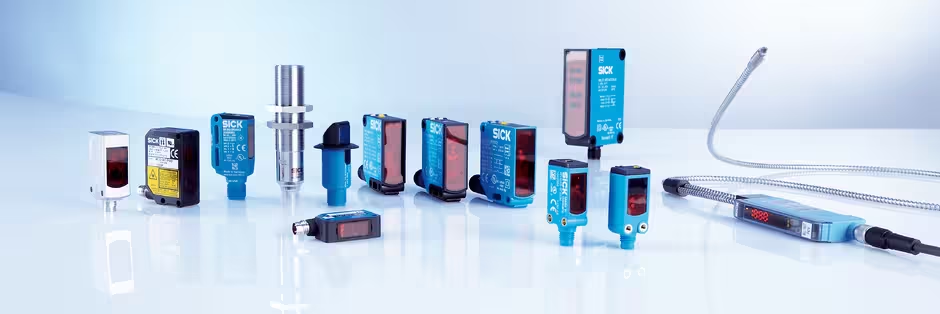
Among other things we have four sorting centres in Switzerland whose nine sorting belts consist of up to 800 mechanical tilt trays lined up one after another. Because of wear it could happen that these suddenly failed during operation, despite quarterly inspections. While looking for a solution we found a suitable partner in the company SICK. We then mounted their laser scanners under all the tracks and configured them together with SICK so that they record a very precise 3D depth profile in the submillimetre range on every pass. The data (around 7.5 TB per day in total, at roughly 250 scans per carriage per day) is captured and analysed on an industrial PC. As soon as a potential problem is detected, a maintenance order is triggered. By now all nine sorting belts are equipped with this technology. Since the system was introduced I am not aware of a single sudden failure. You have to bear in mind that one single stoppage can cost us several hundred thousand francs and, above all, has an impact on our service promise to our customers. We were also able to reduce manual inspections from four to one per year and to organize spare parts stocking more efficiently. This technical solution, with total savings (process and maintenance costs) of more than CHF 1 million per year, was so successful that ideas for further process improvements are already being collected in the department. The goal of this IoT development is to transfer the changes to other mechanical areas as well, for example gantry cranes or other parts of the plant technology.
6 Before you moved to Swiss Post you spent 13 years at Endress+Hauser, a leading provider of industrial measurement technology. There you played a key role in the market launch of Netilion, an award-winning cloud-based IoT ecosystem. What is the most important lesson you learned in that long period?
For that you need to know the core business of Endress+Hauser: high-precision measurement technology. So it is about parameters such as level, temperature, flow and pressure, as well as analysis. During my time there my focus was always on how our customers can make more of the data already available in the devices, because production processes can only be improved effectively with more and better data. In the process industry in particular there are two difficulties: connecting OT and IT, meaning transferring the existing data in OT into the IT world, and interpreting the data. The basic idea behind Netilion was this: we create a framework that simply makes the entire intelligence of Endress+Hauser available to our customers, with the option of capturing the data directly from the measuring devices without complex projects. In theory, users then only had to connect their devices to the cloud, and all the secondary and tertiary values were then prepared in an understandable way alongside the normal process values. As there were already many cloud platforms on the market in 2015, we decided very early to build a state-of-the-art IoT ecosystem. After a software development process that was very agile by the standards of the time, and a high initial rate of adoption, we ultimately worked closely with SAP and also Salesforce in order to offer users even more added value. In this IoT development our strength lay in particular in advising users and in helping them find the solution that suited them best. In the end Netilion prevailed in a hotly contested market in which many others failed. My absolutely biggest lesson was that digitalization does not work if you look at it only from the technical side. So if I do not have a business case with management buy-in that adds up for my IoT development, then I can develop the coolest technical solution, but it will not find any application. My second learning for the implementation of large projects is that you have to bring the people affected along and train them very early. That calls for a lot of change management. My third learning has to do with agility, because if you only show up with your future project once a year, you will never generate enough interest. But if you implement the requirements in an agile way, and the working environment of your contacts slowly changes for the better as a result, then you stay part of the conversation and suddenly you are no longer a supplier but a partner.
7 Which industries and companies are IoT projects worthwhile for, and for which does IoT offer no added value?
I think there is always potential for improvement, in every industry. But a lot depends on the specific form it takes. The logistics industry is of course predestined for it. At the same time I also believe that an IoT development does not always have to bring millions in savings and can just as well have the goal of significantly increasing employee satisfaction. If, as an employee, you have to read off a value every day and write it on a piece of paper, at some point you will certainly lose interest in it. And why would you not? At first it has no added value for your own work, it is simply a repetitive task. But if the value is read out automatically and you are only informed when there really is a problem or when you have to act, then you are probably more satisfied. That can often be solved quickly and inexpensively with technology. A nice side effect is that process quality often improves noticeably as a result.
8 What prerequisites do companies have to meet in order to use IoT successfully, and which strategic considerations are especially important?
Of course it depends on what you want to achieve. If you buy an existing IoT product or an IoT service without doing much yourself, in many cases that can be enough for your use case. But those are then often dedicated isolated solutions. If you want to take the topic on seriously, you very quickly get into the area of having to build your own team with skills in cloud architecture, edge connectivity and sensor technology. And then the most important prerequisite is your own culture. That means management and employees have to want it in equal measure. The company also has to be willing to invest. It is not enough to have a digitalization strategy on paper only. IoT development projects also need a mindset along the lines of "start small and fail fast". We work a lot with PoCs which, if successful, are developed into MVPs and finally scaled. And anyone who wants to build their own on-premise platform above a certain size should definitely examine all use cases carefully for scalability, so that the costs for the cloud platform add up. Last but not least, digitalization projects also mean a high degree of change management, which is why I always find it very important to involve all stakeholders right from the start.
9 IoT development is still a leading topic around digital transformation that keeps companies busy. Where is the journey heading in the next 5 years?
That question occupies us a great deal at Swiss Post. For the even closer merging of AI and IoT we have coined the term "AIoT" internally. On the one hand IoT produces an incredible amount of data, on the other hand AI loves exactly this data. So it is actually a perfect combination of two exciting fields. We have also just created a new staff unit which deals with this topic among others. Unlike a few years ago, today there is essentially a solution for every use case, such as a sensor that sometimes needs more and sometimes less adaptation. I therefore predict that a great deal will still happen when it comes to connecting sensors to various external databases and that the programming effort will not decrease. Even in ten years the art in IoT development will probably still be to link all the different solutions successfully, evaluate them and gain an overall picture.
10 A few weeks ago you accompanied one of your parcel delivery drivers on a shift. How did that come about?
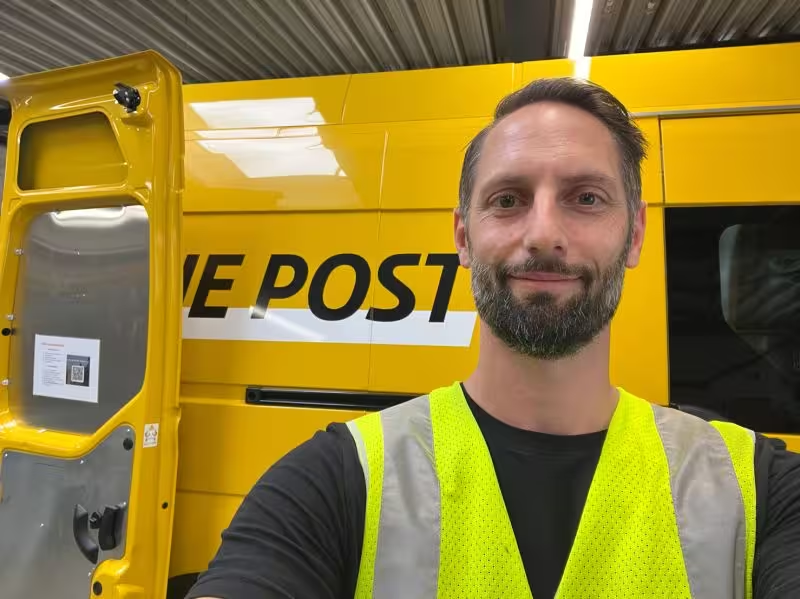
For one thing, it is very difficult to improve a process with an IoT development if you do not know that process first hand. I always want to understand why we do things the way we do them. That is fundamental. Of course the fact that I have only been at Swiss Post for just under a year plays a role too. The second point is stakeholder management. If I understand the process, I can talk to the employees about the important details. Without a deep understanding it becomes very difficult to bring along the colleagues who later have to work with it. I am firmly convinced that this is the only way I have a chance of finding out the things that really matter. To get a comparable amount out of a workshop setting I would need a lot of luck, starting with the selection of participants. At Swiss Post, incidentally, everyone can take a look into other areas, and I can confirm that this is even encouraged by the executive board and is genuinely taken up.
11 Speaking of an innovation mindset: what are the tips you hear again and again but which in your view do not work?
When someone says, for example: "We want to do this with a tablet now." That sets off all the alarm bells for me. It often has nothing to do with digitalization, because the process stays the same. In my experience that happens more often than you would think, so that people try to present the same process in a new guise. Another negative example is starting with the technology instead of with a real business case. I had to learn that myself first, precisely because I spend so much time on new technologies privately. I would then quickly look for a suitable use case because I somehow found the technology cool. Beyond that, you generally should not be too proud and, for example, only want to push through your own solution. Rigidly pursuing your own digitalization agenda without looking left or right is not a good idea either. For innovation to succeed, especially in IoT development, management has to create the right framework conditions and promote innovation. Above all that includes bringing employees along at an early stage, because digitalization always means change, and change is something that people go through.
12 What advice would you give a company that wants to get started with IoT development?
A company that is completely new to the field? Look for a partner. Almost always there is someone who already has experience in the area the company operates in. You can learn so much from the experiences and the mistakes of others, and that usually accelerates your own project enormously. The worst thing you can do is simply start from scratch: with no agenda, without the right people and without the knowledge, which you cannot possibly have yet. A project like that usually fails quickly and is then recorded as a defeat. That in turn leads, not least, to all further projects being discontinued.
13 Which new conviction or habit has improved your professional life the most in recent years?
In my field you must not stand still under any circumstances. That may sound like a cliché, but in truth it is what makes it so exciting. Personally I enjoy it a great deal. Given the speed at which AI is developing at the moment, it is very exciting to see where the journey is heading. That is why I always look at what developments there are, whether technical but above all also social and geopolitical, because ultimately these have an impact on our work and our day-to-day business as well. These days you get information about new developments at every turn, and the art lies more in making a selection and concentrating on the ones that are relevant to you. Sources that come to mind are trade fairs and congresses, scientific articles but also social networks such as LinkedIn, where I quickly form an impression of current trends in IoT development. There are also plenty of podcasts on these topics, for example "Data Masterclass".
Would you like to find out more about how we can support you in the area of technology innovation, for example with research and development or with the development of MVPs? Then read on on our innovation services page. For insights into one of our IoT development projects, head this way to the Alpen Optics case study.

Tech Newsletter
Join our 2,000+ subscribers and receive monthly updates on our latest articles, case studies, webinars, events, and industry news.