KHZG patient portal: how Sana Kliniken are using the Hospital Future Act for digitalization

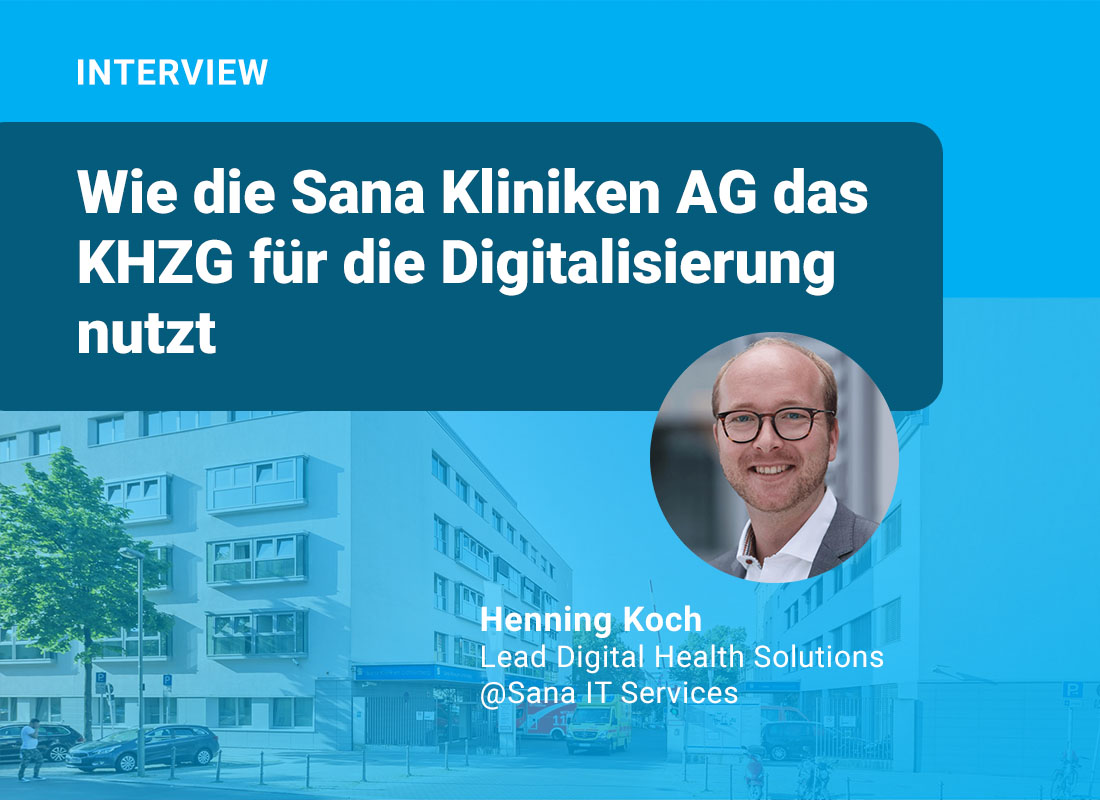
With the Hospital Future Act (Krankenhauszukunftsgesetz, KHZG), the federal government and the states are making 4 billion euros available to hospitals in order to finally speed up the digital transformation of healthcare decisively. But is everything working as planned? And what are the biggest challenges?
In this interview, Henning Koch, Lead Digital Health Solutions at Sana IT Services, gives us exclusive insights into the digitalization strategy and selected projects of Sana Kliniken. He is responsible in particular for the design and delivery of the KHZG patient portal "MeineSana". In this article you will learn:
- why Sana Kliniken have chosen a modular approach for their patient portal,
- how decisive industry-specific software solutions are for digital success
- and how founders can gain a foothold in the highly regulated healthcare sector.
1 What are your goals and tasks as Lead Digital Health Solutions at Sana IT Services?
My core task was originally to identify innovative topics in the health field and to check whether they are relevant and cost-efficient for patients as well as for staff. That approach involved screening external solutions, running proof of concept pilots in our hospitals for validation and finally assessing how suitable they are for the group as a whole.
With the arrival of the KHZG, the requirements of my position changed. In particular, I was given the project of the KHZG patient portal "MeineSana", which is being delivered under funding category 2. Right at the start we decided not to award the project to a general contractor, but to use a best-of-breed approach instead. To do that we divided the project into modules or subject areas for which different companies are responsible. Appointment management and video consultations were taken on by Doctolib, for example, while Recare is responsible for discharge management. For the exchange of data and documents between institutions, two companies were chosen: Visus Health IT is responsible for the repository and the long-term archive, while InterSystems runs the communication servers. We also outsourced the integration of all components into a single overall solution to Avelios Medical, a young company from Munich.
2 Through the KHZG, the federal government and the states have been supporting hospitals with 4.3 billion euros for digitalization since the end of 2020. Where do your KHZG projects stand at the moment?
Sana Kliniken AG has benefited from KHZG funding, and all the projects we applied for were approved. Delivery is proving challenging, though, because different federal states have different funding conditions and deadlines. The time pressure means focusing on delivering the mandatory criteria, with aesthetic design taking a back seat for now. For each Sana hospital we created a dedicated position, "head of clinical processes and digitalization", to manage and deliver the KHZG projects in that particular institution, and we rely on structured working methods such as using blueprints in JIRA to ensure coordinated delivery and a standardised rollout.
Sana Kliniken AG consists of various institutions acquired over the years, each equipped with its own systems that have grown historically. When it comes to HIS (hospital information system) or clinical workstation systems in particular, across our hospitals we use pretty much everything that is available on the German market. Accordingly, a topic as overarching as delivering a KHZG patient portal is relatively demanding in terms of the different providers and interfaces. Despite some delays in the tendering procedures, our KHZG projects are in the upper middle range of the German market. To meet the time requirements, however, we have to pilot very quickly and therefore cannot allow ourselves much of a learning curve. We will have to keep working very much in parallel, which means we start with one hospital and then four to six weeks later we begin with the second one, and so on.
3 All hospitals have to deliver their KHZG-funded projects more or less at the same time, within statutory deadlines. What role does the competition for digital specialists play for you?
Skilled staff obviously play a decisive role for us too. The degree of process digitalization or transformation that we are all going through affects not only the patient experience but also the working conditions of our staff. Nobody wants to fall back on pen and paper any more. Future employers are therefore being assessed on how digitally they are set up. Although we are still on our way and our level of digitalization is average, we are actively working to improve it. The appointment of our new board member Stefanie Kemp as chief transformation officer signals a stronger prioritisation of topics such as standardisation and harmonisation, which are relevant for skilled staff as well.
Like the whole sector, we also have staff turnover. But we recognise the importance of a digital working environment and are approaching the challenge strategically, in order to reduce turnover and attract skilled people. I believe the digital state of a company or a hospital will be an increasingly important deciding factor, not only from the patients' point of view but from the staff's as well. In our private lives we all rely on digital tools. Things are developing extremely fast, and employers therefore have to stay on the ball and communicate the advantages of digitalization convincingly in order to win the skilled people they need. It is no longer a given that applicants come to us on their own. In the current market we more or less have to apply to them.
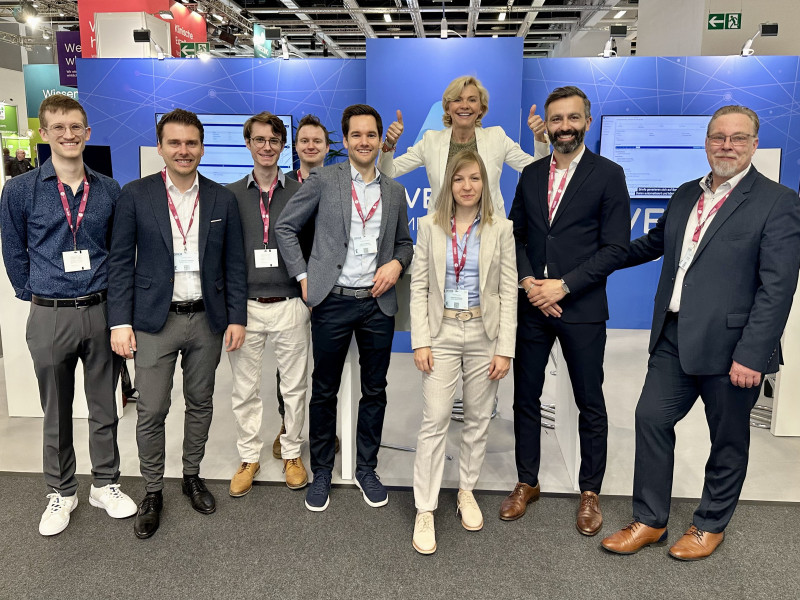
4 For appointment booking and video consultations you use Doctolib, and for discharge management Recare. How important is industry-specific software for your digitalization plans?
The choice of industry-specific software plays a central role in our digitalization plans. There are many HIS systems on the market that are aware of their dominant position and that now, in a saturated market, make their money from maintenance contracts, interfaces and so on. Accordingly, we always have the challenge with HIS vendors of integrating the solution into our systems.
In the tenders we ran for the KHZG patient portal, however, we are not only integrating the big players. While Doctolib and Recare have now grown into market leaders as providers, we also brought in smaller but flexible companies such as Avelios. The smooth integration of the individual components is without doubt our biggest hurdle. Because simply buying a one-size-fits-all solution is successful only in the rarest of cases. Smaller adjustments and fine-tuning are therefore unavoidable. Our new architecture guidelines and clear specifications for suppliers and partners do support us with standardisation and harmonisation, though.
5 You are currently building your own KHZG patient portal with "MeineSana". How do you want to use it to achieve more efficient medical care?
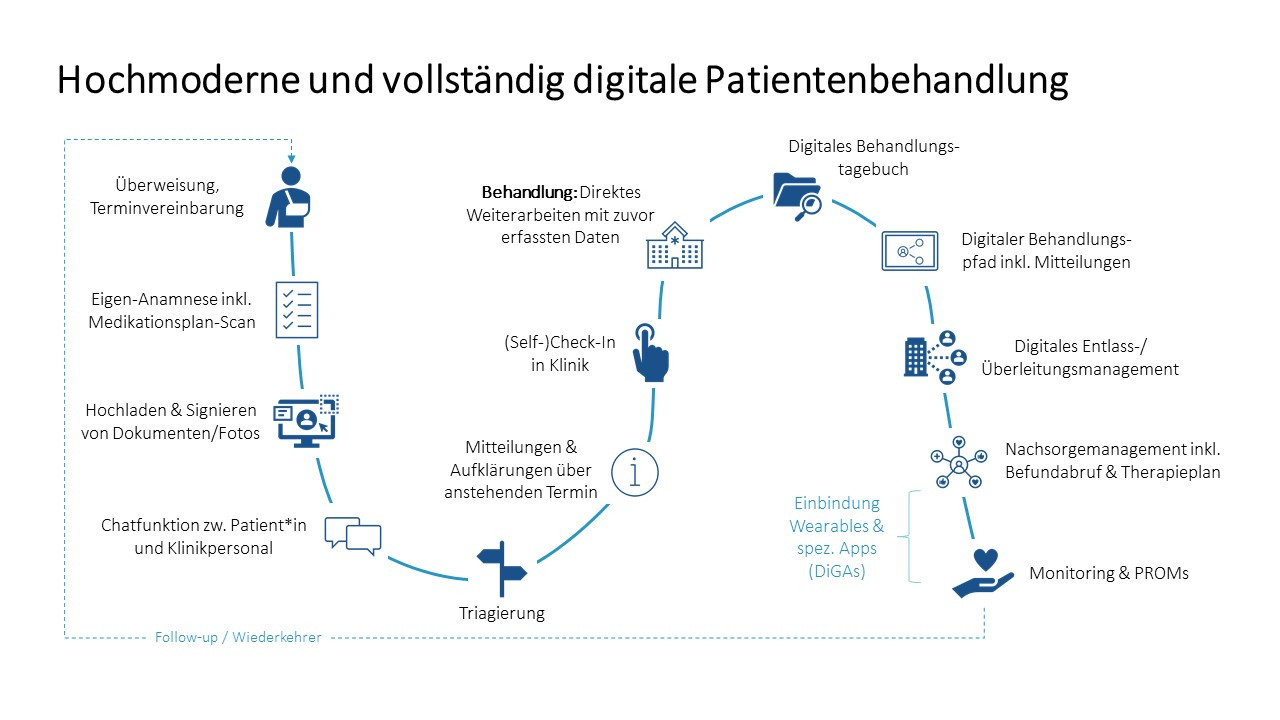
Developing "MeineSana" as our own patient portal under the KHZG is a strategic step for us. The battle for the smartphone is in full swing. At this moment around 1,800 patient portals are being created across Germany, and our ambition is of course to become one of the leading ones. As a holistic health service provider, our goal is not to build just another patient portal, but rather to offer a comprehensive health universe that accompanies the entire patient journey. By bringing in various offerings, from prevention and symptom checkers through to appointment scheduling and the supply of medical aids, we are pursuing a holistic approach that meets the individual needs of our patients.
To make sure that "MeineSana" meets our patients' requirements, we ran intensive workshops with various user groups. From patients through to nurses and doctors, we defined what is needed from the portal. We place great value on user-friendly design and functionality, because we are convinced that only a portal that is intuitive to use and aesthetically appealing offers users real added value. And at the end of the day, whatever generates added value and creates benefit will prevail. Our partnership with Avelios, a flexible company, allows us to respond quickly to change requests and to make sure that "MeineSana" is continuously adapted to changing requirements. That includes staying up to date on innovative technologies and on political decisions, for example regarding the electronic patient record.
6 The KHZG can only be the beginning. Compared with others in Europe and worldwide, we lag behind on digital maturity. What is one important point for reforming the German health system so that catching up is sustainable?
The German health system faces the challenge of developing further and closing the digital gap in order to stay internationally competitive. A decisive aspect here is the need to be more willing to experiment and to dial the bureaucracy down a little. We often think we can do many things better. We want to do something perfectly, we discuss topics for a very long time and we try to think through every special case, instead of simply trying things out. It takes a culture of trust and courage to try new approaches, rather than smothering everything with the most precise regulations. Although healthcare traditionally lags ten to 15 years behind other industries, there is still the chance to make a big leap forward through bold innovation and the use of modern technologies such as GenAI.
7 In your career you have both worked in a start-up yourself and helped start-ups gain a foothold in healthcare. What do you advise young founders?
I advise young founders in healthcare not to concentrate only on the idea or the technology, but also on the industry knowledge they need. It is decisive to bring experienced specialists into the team who already know the way through the complex jungle of healthcare and can offer valuable support. Although the process can be lengthy, costly and heavy on regulation, healthcare also offers stable sources of revenue and a solid basis for growth. Flexibility and the ability to spot and use gaps are decisive for gaining a foothold successfully and establishing yourself in the health sector in the long term. Because once you are in, you do not get thrown out again that quickly.
Beyond that, it is important to develop a business model that is both understandable and compliant with regulation. Start-ups should definitely explore the possibilities in other markets as well before concentrating exclusively on the German market. Germany is a very attractive market, but not the easiest one.
8 What does the hospital of the future look like, and what role do platforms play in it?
The hospital of the future will increasingly be shaped by platforms such as the KHZG patient portals, which integrate a wide range of solutions and services. We deliberately designed "MeineSana" as an open platform that offers maximum connectivity and makes it possible to integrate the best solutions on the market. This platform thinking extends to our entire IT landscape, where we are aiming for standardisation in order to increase efficiency and use resources better. By introducing a single platform, staff can move seamlessly between different institutions because they are familiar with the same systems, which leads to improved efficiency and smoother operations.
Platform thinking is firmly anchored with us, and with it the openness to develop specific regional offerings or to work with new technical partners. This openness allows us to learn from different sources and to identify the best approaches for our patients and our staff. We are always keen to look beyond our own horizon, for example to countries such as the US, the UK or Sweden, to explore best practices there, while always having to check that the concepts we adopt can be sensibly adapted to our needs.
9 Which technologies have the greatest potential for digitalizing healthcare as a whole?
The digitalization of healthcare is being driven substantially by technologies such as generative AI, particularly in support services. One promising development lies in using AI to evaluate medical images. I believe the greatest potential lies in a mixture of artificial intelligence and human intuition and empathy. By supporting doctors with diagnosis and treatment, the technology enables more efficient and more precise patient care. In addition to automating and taking pressure off administrative tasks, technologies such as AI have the potential to improve data evaluation and generate new insights, which can improve the quality of medical care in the long term.
Would you like to find out more about how we can support you in digital health with the design and delivery of software projects? Then read on at our healthcare services page.



Tech Newsletter
Join our 2,000+ subscribers and receive monthly updates on our latest articles, case studies, webinars, events, and industry news.