A tool, not a cure-all: how companies bring AI down from the pedestal and into practice

Intelligent assistants, automated decisions, content at the click of a button. AI has long been part of everyday life and is already shaping how we work, lead and think. Even so, many questions remain open: where does sensible use begin, and where does the hype end? And what attitude do companies need in order to realise the technology's potential responsibly?
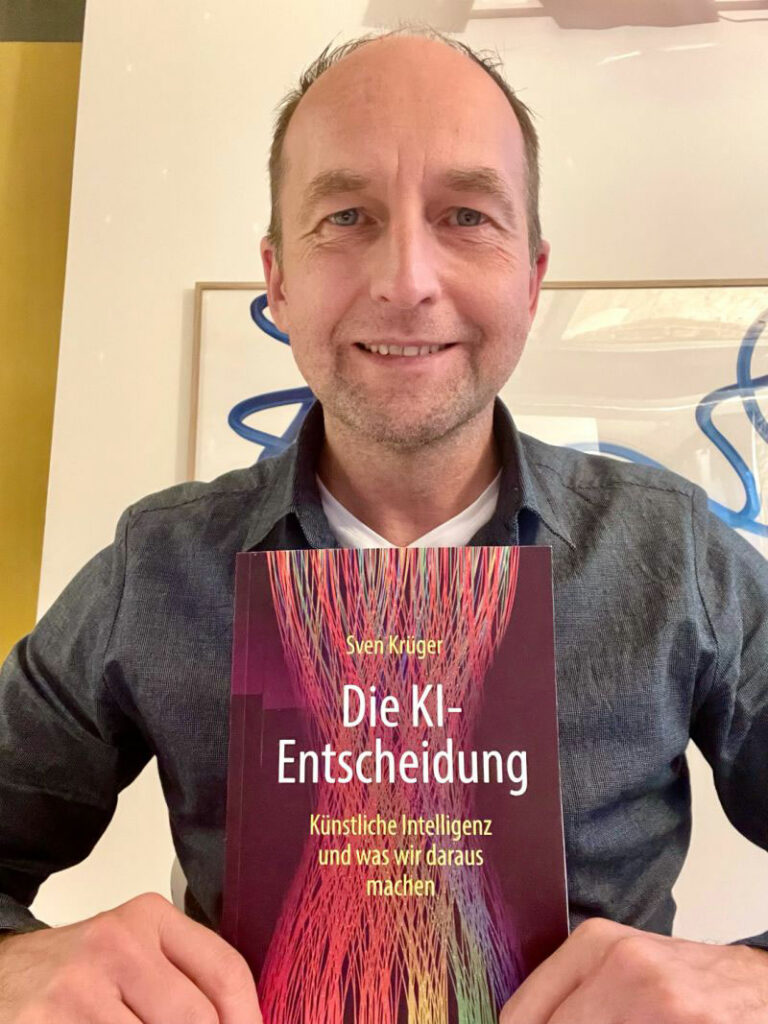
We spoke about this with Sven Krüger, formerly CMO at T-Systems and adesso, today an executive coach, consultant and author of the book "Die KI-Entscheidung" (published in 2021). In the interview he explains, among other things:
- why ChatGPT is only the beginning and where the really big levers lie
- what homework companies have to do before a first AI pilot makes sense
- how leaders can park their ego, empower teams and make the leap into the AI era
1 After more than 20 years in industry you resigned to concentrate fully on your work as an executive coach. How do you use AI in your own daily life today?
I have worked with AI professionally for a very long time, but for years there was hardly any way to use it practically as an ordinary user. At the moment I mainly use the big LLMs as a sparring partner: when I have an idea, I let the model think along with me and dig deeper, which they are very good at.
For years I have argued that sooner or later every first contact will be a bot contact. Each of us will have at least one personal virtual assistant in the form of a software agent that filters calls, answers emails and takes over everything that can be automated. That era is starting now, and the first people are already building their own agents for specific purposes. For my own day-to-day work as a sole trader, though, the effort of automating complete workflows is not yet worth it. Like every smartphone user I obviously also use AI invisibly in many standard functions, but consciously I mainly work with the large language models and with smaller automations.
2 Your book "Die KI-Entscheidung" came out at the end of 2021. Which developments in AI have surprised you most since then?
What surprised me most is the speed at which everything is developing. In my book I underestimated how quickly transformer technology and the GPT models that came out of it would take off. Today millions of AI experts suddenly appear, just because anyone can have an OpenAI account. You can smile at that, but at the same time I am pleased that the topic has reached such a broad audience, because that was exactly the goal of my book: more people should understand what AI is and what it is not.
I am equally amazed by how capable the models are at inference, at what you could almost call "thinking". Three years ago hardly anyone would have predicted that we would achieve results like this in such a short time. That said, I advise caution with terminology. In webinars I often hear that software agents should be treated like real colleagues. I take a different view. Language shapes our thinking; when we talk about AI, the models quickly take on the appearance of independent beings, which I consider misleading.
At the same time, the quality of these systems shows clearly in how well they simulate human dialogue. Today you chat with a system and can no longer be sure whether there is a human or a bot on the other side. The Turing test, barely crackable for decades, has effectively been settled. It works on the phone too: we could talk to each other and you could not prove with certainty that I am really sitting here in flesh and blood.
3 In your book you clear away "hype and myths" around AI. Which clichés do you still come across most often today, and how do you clear them up?
When people hear the word hype, many think of something passing. That does not apply to AI. It is still at the beginning, but it will fundamentally change the way we live and work. In 20 years a lot will be unrecognisably different: working life, society and communication. The biggest mistake anyone can make is to ignore the topic.
Often I see the opposite, though: AI is simply pushed into existing structures. Somebody is supposed to take care of it quickly, start a pilot with no real goal or mandate. That rarely works. Implementing AI means a massive and often unwelcome change: a business model that works today has to be moved into a new, AI-supported business, or even replaced. As a rule that requires teams working on nothing else, closely tied to the core business rather than sitting in a distant innovation lab. Regular, facilitated exchange stops the new ideas from losing their grounding and their contact with reality. Exactly what the ideal change process looks like depends on the industry, the culture and the people. There is no one-size-fits-all.
4 You warn against mixing science fiction and reality when it comes to AI. How can companies keep a cool head and use AI pragmatically?
The most persistent cliché is anthropomorphising the technology. Many people talk about AI as if it were a being with a will of its own. I always stress that these are machines doing exactly what they were built for. Many developers build these systems and most of them are simply doing their job, like a car or a kitchen appliance does. As soon as you start talking about "Skynet", the Terminator or a looming superintelligence, you lose sight of the actual technology.
I consider that dangerous. Because if you forget that these are machines, you quickly end up with absurd demands, such as special rights for robots. There are even projects researching "the welfare of algorithms". I position myself clearly against that.
Anyone who digs deeper quickly notices that the hype of the past three years concerns only a small part of the AI world. Everyone talks about language models, but the bulk of applications are classic programs with no language component at all. If you understand, and do not forget, that we are dealing with algorithmic systems, you can talk about opportunities and risks factually without sliding into science fiction fears.
5 Which structures, processes and skills do large and mid-sized companies have to build before they can seriously start with AI projects?
From the perspective of most companies, the first step is often to ask honestly: who are we today, and who can or do we want to be tomorrow with AI? It is worth looking beyond the edge of your own bubble for that, even if it is unsettling. After that comes an inventory: which systems, data, skills and processes exist? Often it turns out that the know-how is missing, so a large reskilling effort follows.
At the same time, promises of salvation are proliferating: "if you do not use AI right now, you will be gone tomorrow." This FOMO leads to activity for its own sake. A cool head is better: assess the opportunities soberly, invest time and energy in clean foundations and bring in external expertise instead of making every mistake yourself. AI is a long-term change. One of my talks is called "AI is ready, are you?", because the technology is often ready and available while organisations and people frequently are not, not even for "normal" digitalization. Germany as a whole is still lagging behind there.
6 Which obstacles have your clients at adesso most often run into with their first AI projects, and what has proven effective in overcoming them?
I cannot say much that is specific to adesso here. What the companies in question often lack is a clear idea of what AI is supposed to solve. Because "we need AI" is not a goal. Only when a concrete use case exists does AI become a product or a solution with a name, a price, a term, features and liability.
So: first define which automation genuinely helps. Then check whether systems can be connected, whether APIs and data quality are sufficient and which regulatory requirements apply. Without a reliable data basis, even the best AI is of no use; it makes decisions only on the basis of the data it is given. In the end, success or failure of a project is usually decided by the company culture and the mindset of the people involved, including their ethical stance.
7 How do you currently assess the tension between European regulation and the more market-oriented approach in the US?
Aleph Alpha was seen as Europe's LLM hope; realistically that is no longer the case. Globally, US and Chinese tech corporations dominate, and the only exception that plays a global role is SAP. Europe does have expertise and individual niche successes such as DeepL, but the digital infrastructure is determined by US platforms. Even considerable investments such as the Schwarz Group's AI campus in Heilbronn are pocket money from a US perspective. As long as we do not mobilise capital, minds and infrastructure on a large scale, this dependency will remain.
You can see it in everyday life too: all the relevant platforms are American, and every few months when one of them, WhatsApp for example, changes its terms and conditions, three dozen influencers immediately appear to explain how to word an objection. That reflex shows the state of the digitalization mindset in Germany: we use free US tools, feel powerless and shout "objection!". It is similar with the GDPR: since it came into force, I hardly reach a website without first clicking away an armada of disclaimers. Can our marketers really not come up with anything better? I find that regrettable, but I do not let it discourage me: Europe offers a high quality of life, strong values and can attract clever people. What we need, though, is more speed and bolder investment, otherwise we will stay in the second or third row.
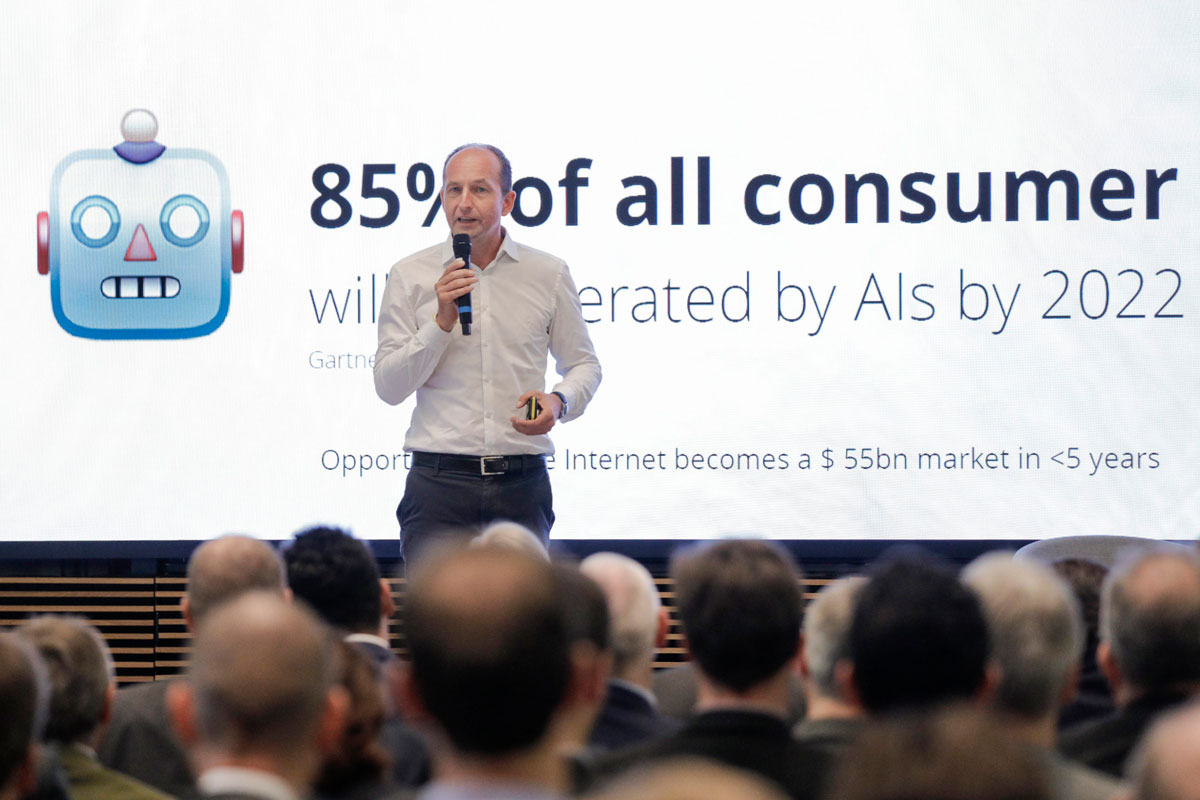
8 Your keynote topic "AI ethics: good and evil machines" underlines the importance of responsible AI. Which steps do you recommend to companies so that ethical principles are upheld?
Ethics has to be lived top-down. The behaviour of the leadership shapes the company culture. Laws provide the minimum; ethics goes further and orients itself towards what society considers right.
A practical tip: listen to voices that are not on your own profit side, tenants, patients or customers for example. That way you spot early where you might end up in an ethical grey area, and other people's view shows how the company is actually perceived. Transparent processes, clear control mechanisms and equal treatment that can be traced create trust. Particularly in Germany and Europe, liability questions are strictly regulated, which is why this works in most companies. The vast majority of actors do not want to do anything illegal, but they often move in grey areas without noticing.
An example: you find interesting correlations in your data and immediately think, "I am going to use those." That is exactly where I first ask myself, "am I allowed to? Under what conditions? What safeguards do I need?" In many cases it is possible, but not bluntly, only after a proper weighing up, which can also happen quickly, because most people already have a healthy intuition about what is morally right or wrong.
9 From your point of view as an executive coach: which leadership qualities are more important than ever in these fast-moving times with their rapid AI progress?
I have accompanied leaders through technology-driven change processes for years. These days upheavals like that no longer happen slowly, but overnight or within 18 months. There is no single correct leadership style for it. Three things are decisive: first curiosity, in order to stay open to new things; second a clear ethical stance, because without trust in the team it becomes difficult; third the ability to take your own ego out of the equation.
Someone who has successfully built something up over ten years is not automatically the best person to rethink it in a digital environment. Sometimes good leadership means handing over responsibility and letting others step forward who have the better answers in the current phase. That calls for openness, tolerance for new ideas and the willingness to let go of functions you have grown fond of. In short: yesterday's leader is not necessarily tomorrow's, but they can steer the change by putting the right team in place and consistently setting an example of what responsible action looks like.
10 Looking into the crystal ball: which two or three AI-driven changes will shape the German Mittelstand most by 2030?
I deliberately do not commit to precise scenarios, and I could not anyway. Three or four years ago I would have assumed that an AGI (artificial general intelligence) would only arrive in 20 years. By now I hear forecasts for 2028 to 2030. Whether there will be one AGI or several, whether they will develop into superintelligence and whether they will remain controllable is all open. I find it remarkable that many clever minds such as Geoffrey Hinton, Ray Kurzweil, Elon Musk and Sam Altman are voicing serious concern publicly.
That is technologically fascinating, but in my opinion something else is decisive, namely social cohesion. The polarisation of recent years worries me more than any new technology. Because in the end it is people who decide how technology is used. So we should ask ourselves more often what kind of society we want to live in, and move closer together for that instead of letting ourselves be divided further.
Would you like to find out more about how we can support you with the design and delivery of intelligent software solutions? Then discover the most common use cases and selected references on our AI consulting page for companies.

Tech Newsletter
Join our 2,000+ subscribers and receive monthly updates on our latest articles, case studies, webinars, events, and industry news.