llms.txt: why content-heavy projects need an AI map


TL;DR
Find out how the /llms.txt file optimises your website for AI systems. The journey is heading towards llms.txt as the way to make complex websites such as customer portals GEO-ready. While traditional SEO standards like robots.txt guide search engines, /llms.txt acts as a curated treasure map for large language models. Instead of blocking content, it shows AI systems the direct route to your most valuable resources. For extensive platforms and portals with hundreds of articles and subpages in particular, this Markdown file is becoming essential. It solves the context window problem of modern AI and makes your content findable exactly when ChatGPT, Perplexity or other AI tools are looking for answers. We already apply the following best practices in our content-heavy customer projects.
The technical paradigm shift: from SEO to GEO
As developers we know the problem from our customer projects: modern websites are complex constructs of HTML, JavaScript, dynamic content and nested navigation structures. For large language models (LLMs) that is a major challenge. The token limits of current models force us to rethink. Not all content is equally important any more; we have to curate and prioritise. The journey is clearly heading towards llms.txt as the new standard for GEO-ready portals.
The /llms.txt file is not another compliance tool like robots.txt. While robots.txt instructs crawlers on which areas of a website may be visited, and sitemap.xml lists all URLs for indexing, /llms.txt takes a fundamentally different approach: it is a curation file for inference-time access.
Understanding the format
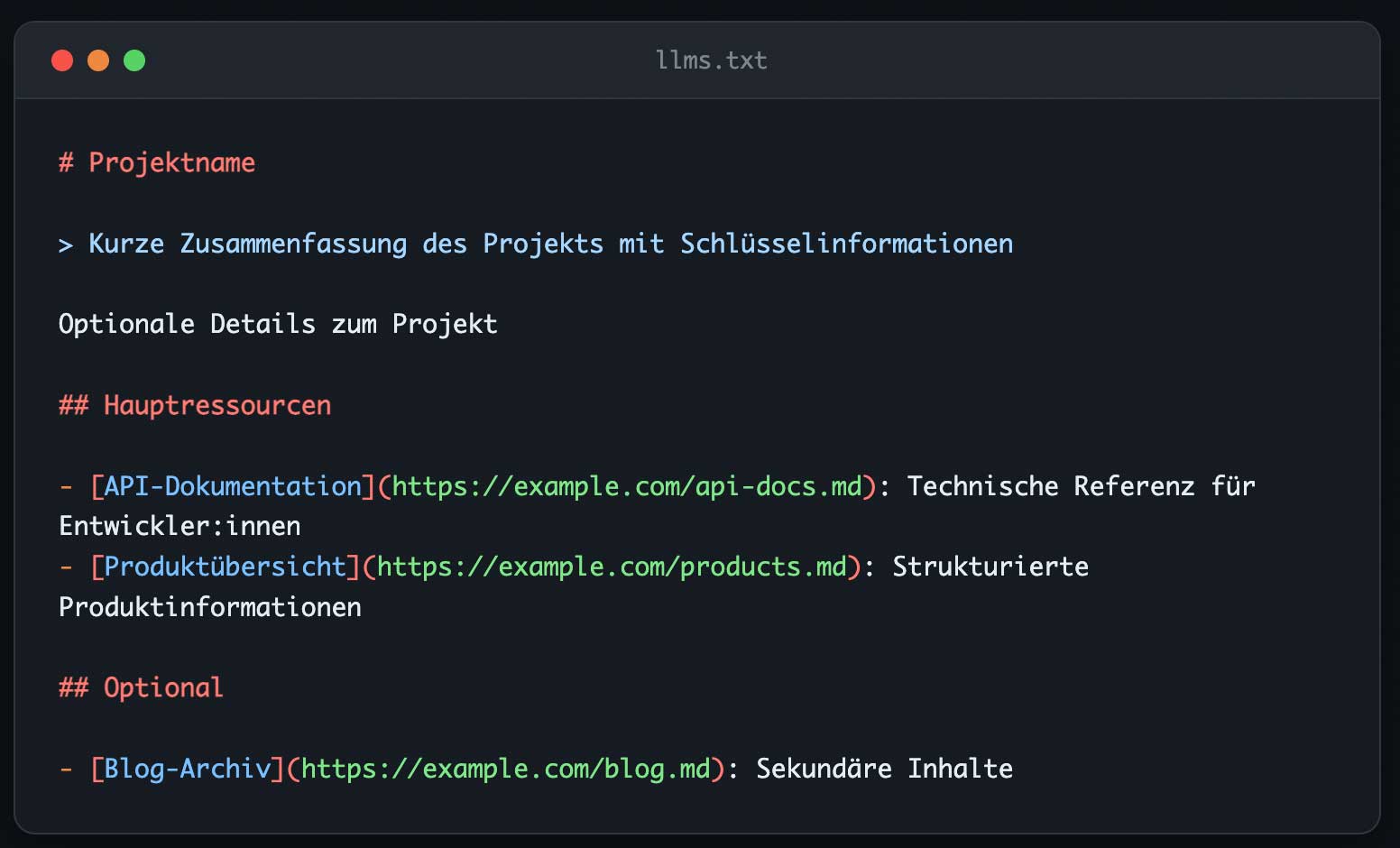
The file deliberately uses Markdown rather than XML or JSON. That is decisive, since LLMs work best with content structured in Markdown. The specification we apply in our projects sets out the following structure:
Technical implementation for content-heavy projects: our best practices
For complex website projects with hundreds or thousands of articles (relevant well beyond our focus on the publishing industry, by the way), we at SPRYLAB have developed specific best practices:
1. Content prioritisation: not every article of yours is of equal value to AI systems. In our customer projects we use the /llms.txt to mark the most relevant articles, the ones with clear structure, semantic markup and high information content.
2. Providing Markdown: the specification recommends providing a .md version for every important page. For a URL such as https://portal.example.com/kb/installation-guide, the Markdown version would be available at https://portal.example.com/kb/installation-guide.md. We implement this structure as standard in our content management systems.
3. Using structured data: LLM-friendly content means the following in our customer projects:
- Short, scannable paragraphs
- Clear H1 to H3 hierarchies
- Lists and tables instead of continuous text
- Semantic cues such as "Step 1:", "Summary:", "Key point:"
The difference that matters: crawling versus inference
One critical point that we keep stressing in our consulting: /llms.txt is not used to train AI models, but for inference-time access. When users ask ChatGPT for information about your product, the model can access your /llms.txt in real time and retrieve the curated content.
In concrete terms that means:
- No influence on model training
- Real-time access when users ask questions
- Direct links to relevant resources
- Getting around navigation hurdles and JavaScript barriers
Practical considerations for large platforms: lessons learned from our projects
When implementing this for projects with a large volume of content, we prioritise three things above all:
Hosting compatibility: not all hosting providers support access by AI bots. In our enterprise projects we make sure the infrastructure is AI-ready.
Content transformation: we use web scraping APIs and our own tools to convert existing HTML content into clean Markdown structures automatically. Tools such as the llms_txt2ctx CLI expand /llms.txt files into complete context files.
Versioning: where content is updated frequently, we implement version control for the /llms.txt file. The FastHTML documentation shows by example how automated pipelines keep the Markdown versions in sync, an approach we have successfully adapted.
Integration into existing architectures: how we make your platform GEO-ready
The /llms.txt file complements existing standards, it does not replace them. Here is what we see in our customer projects:
For development teams that means: /llms.txt can be implemented alongside existing SEO measures without adapting legacy systems, an approach we have already delivered successfully in migration projects.
Conclusion
The journey is clearly heading towards llms.txt, and at SPRYLAB we are right in the middle of it. As a specialist for custom platform solutions and complex, demanding websites, we already integrate these best practices as standard into our content-heavy projects. The era of generative engine optimisation (GEO) has begun, and we make sure your complex portals and websites are ready for it.
Whether an extensive customer portal, a technical documentation platform or a knowledge-intensive company website, we make your digital content optimally accessible not only to people but to AI systems as well.
Do you have an idea for a next digital project where you want the big LLMs to find your content too? Then book a free initial consultation with one of our technical specialists now.


Tech Newsletter
Join our 2,000+ subscribers and receive monthly updates on our latest articles, case studies, webinars, events, and industry news.