Experienced IT partner for hassle-free process optimization with AI
As a leading artificial intelligence agency, we support large and medium-sized companies in determining if and how they can benefit from process optimization with AI. To do this, we examine your workflows and systems to identify potential and develop new solutions for your processes. We rely on technical expertise, iterative development, and a wealth of project experience.














What is (still) slowing down your AI process optimization project?
The drive to innovate is there, but your existing internal processes, methods, and mindsets are holding back faster progress. In that case, you are likely familiar with one of the following hurdles.

Lack of strategy
You know that trial and error can get expensive. But are you unsure where to start with AI integration to get the most value out of it? To ensure artificial intelligence doesn't become a cost trap, you need a strategic plan for your AI journey.

Lack of AI expertise
Effective AI systems require suitable data of reliable quality. Many of our clients need to improve in this area. Do you? Often, organizations lack the in-house data scientists and AI experts needed to confidently drive the development of data-secure and legally compliant AI systems.

Lack of trust in AI
Artificial intelligence can only reach its full potential if your employees know how to use AI systems correctly. Your company must proactively manage change by communicating transparently about reliability, GDPR compliance and data security to reduce internal skepticism.

High cost pressure
You are working with a limited budget and often need to deliver results first to gain internal support for further AI initiatives. Is custom development worth it, or can performance leaps be achieved with standard AI chatbots? These decisions have far-reaching consequences.
Process optimization with AI is our specialty
Artificial intelligence can be a value driver for any company. If you know how. As an artificial intelligence agency, we are your full-service partner for every aspect of your project.
Sustainable strategies, the right tools, and suitable use cases – we analyze your current situation in a customized workshop. We identify optimization potential and possible next steps, and develop a realistic roadmap for your own AI journey.
Already have an idea for an AI use case? We use agile innovation sprints to develop an initial prototype that demonstrates the potential of your application and identifies the necessary prerequisites. The result: we gain a deep understanding of your ideal AI solution.
Need a specialized solution? We develop your custom AI system using an iterative methodology, starting with a Minimum Viable Product. Based on user feedback, we then provide data-driven support for the ongoing development and optimization of your application.
The 8 Most Common Use Cases for AI Solutions
As an AI agency, we integrate your AI system into a wide variety of processes and business areas. Get inspired by how you, too, can put this technology to work for you.
.svg)
The most promising use case is process optimization. Systems that leverage RAG and AI assistants can do more than just handle simple tasks; they can read your documents, pick orders, generate forecasts, and efficiently complete many value-adding activities.

AI chatbots using RAG (Retrieval Augmented Generation) are revolutionizing customer service: they can hold human-like conversations with your customers, allowing them to resolve many issues on their own. This can reduce your ticket volume by more than 20% on average.
.svg)
With AI, you can capture, organize, and utilize your company-wide knowledge more effectively. AI automation, pattern recognition, and advanced analytics reduce time spent on tasks and significantly improve your team's decision-making.
.svg)
AI allows you to intelligently process and leverage valuable customer behavior data. This provides the foundation for engaging your customers with personalized content at the right time, presenting them with individual offers, and significantly increasing your sales conversion rates.

Use the ChatGPT AI model as a powerful foundation for your custom enterprise AI. As an AI agency, we train a custom GPT version using your data, tailor the application to your specific needs, and ensure data-compliant deployment.

Personalized recommendations aren't just for Amazon and Netflix; they are a powerful tool for customer retention and revenue growth. With AI algorithms, your company can also benefit from smart recommendations to boost up-selling and cross-selling.

Extend the lifespan of your machinery, avoid costly production downtime, and shorten repair times. Artificial intelligence can monitor your machine functions and significantly increase uptime in your manufacturing operations.

Enhance your company's protection against damaging attacks and fraud attempts. Advanced AI algorithms detect policy violations and irregularities in usage patterns in real time, allowing for immediate protective measures.
Our proven approach for your successful process optimization project
We guide you from concept to go-live for your AI system using proven methodology, balancing structure with flexibility. Leverage our 17 years of transformation experience to upgrade your processes with trustworthy, custom AI.



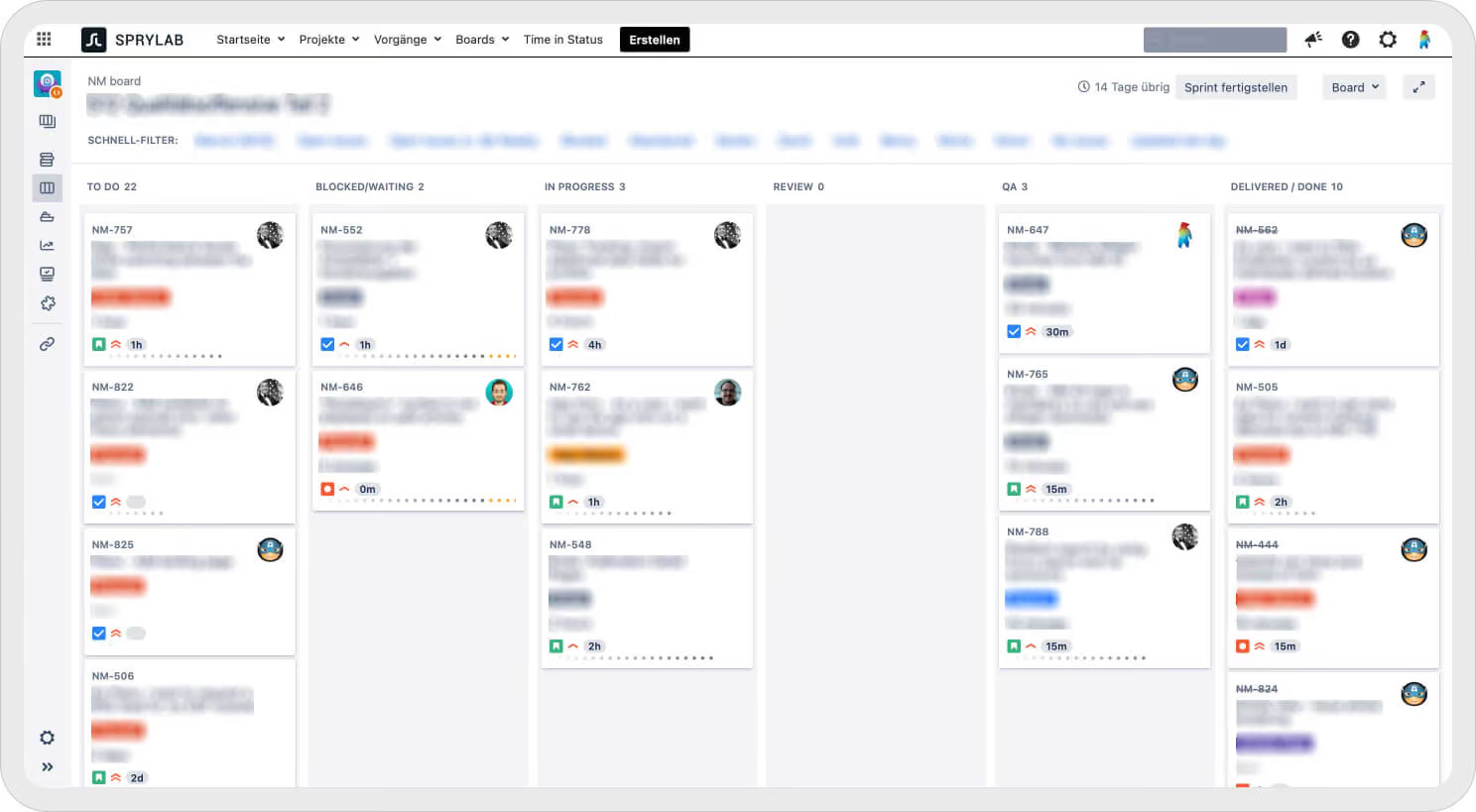

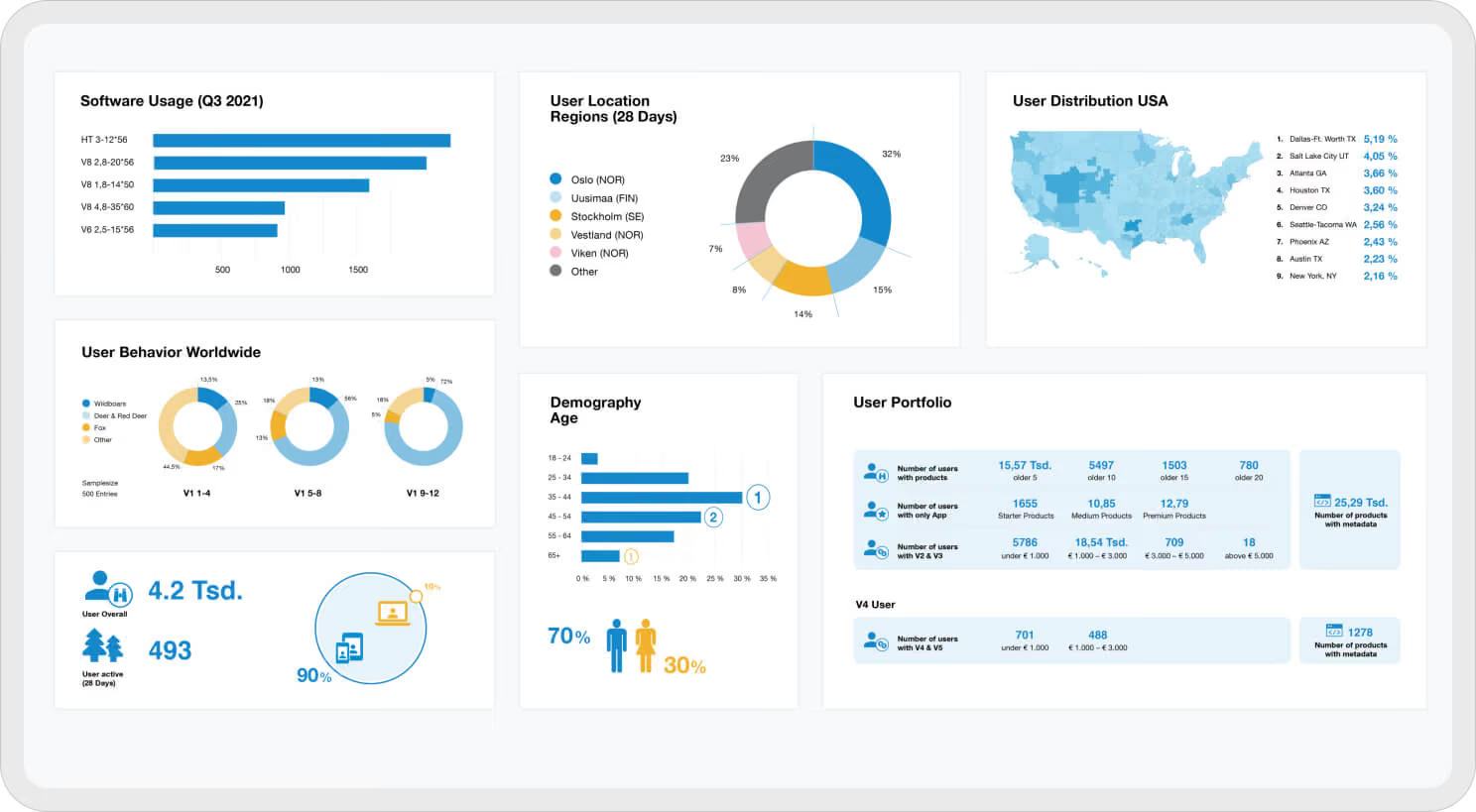
Ambitious requirements are our passion
We leverage a variety of AI technologies, tailoring their application to your specific requirements and existing IT infrastructure. Furthermore, we provide consulting services to determine the optimal hosting solution, whether via major cloud providers like AWS or Azure, on-premises servers, or smaller providers.





5 reasons why SPRYLAB is the AI agency you’ve been looking for
Whether your goal is increased efficiency, revenue growth, or AI-driven innovation, our expertise and experience in AI development ensure a successful project. We deliver on time, within budget, and to the highest quality standards.
We have built deep expertise through more than 15 AI projects. Our own SaaS product, featuring integrated AI modules, also serves as our innovation and testing ground.
Looking for AI innovation, and fast? We bridge the gap between quality and speed in AI development, thanks to our agile methods and custom best practices.
In 17 years of software development, we have always delivered the results we promised—83% of our new projects come from referrals.
With over 150 client projects under our belt, we know why software projects fail and reliably ensure that yours becomes a success story.
High-performance AI systems are always built by teams. We provide honest, peer-to-peer consulting—and we aren't afraid to address uncomfortable truths directly when necessary.
Over 15 AI projects successfully completed
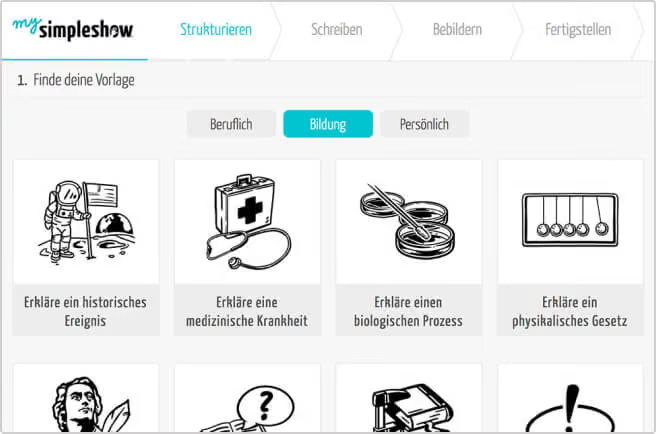

AI-powered video platform
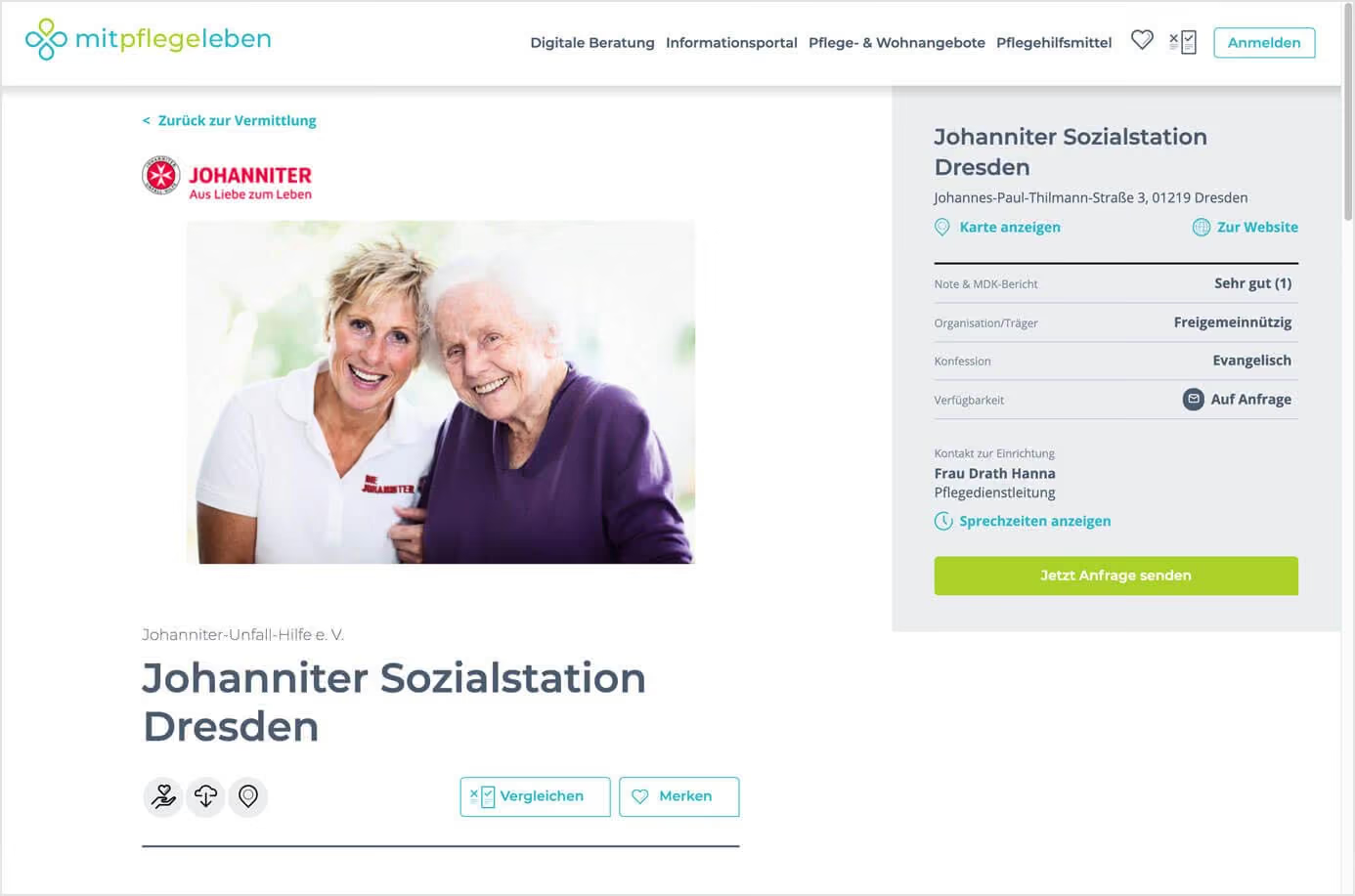

Intelligent chatbot
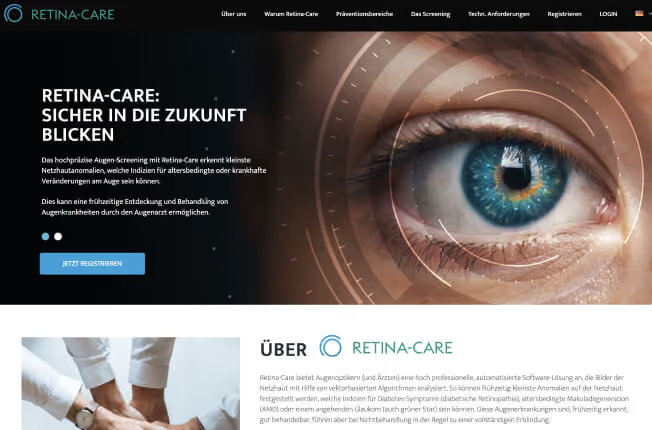
AI analysis software
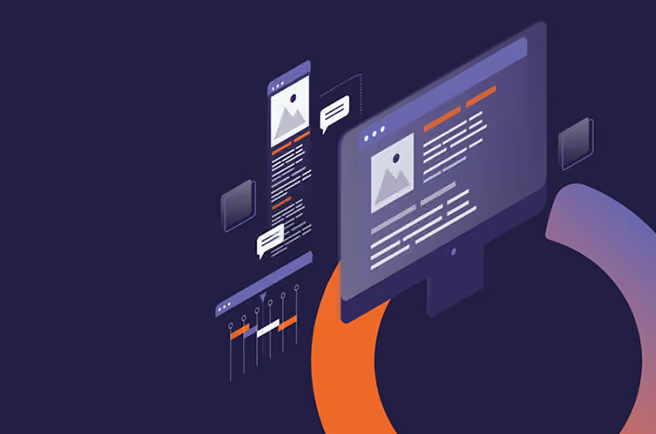

AI features for SaaS
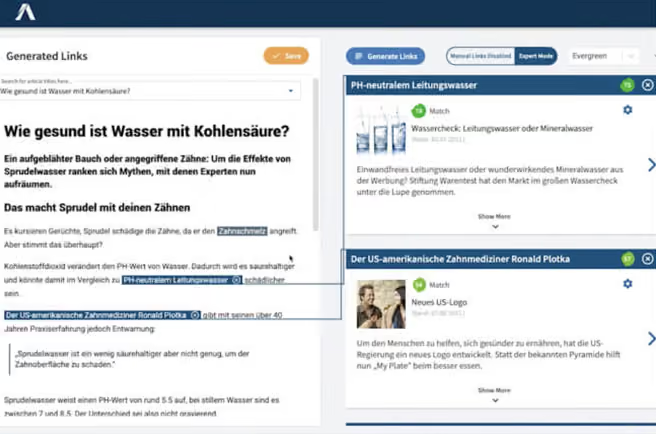

Integrated AI module


Digital AI training
What our clients say about us



Would you like to bring your idea to life with us? Get in touch!
Challenging projects drive us. If you are looking for an AI agency to improve your processes, we are the right partner for you.

Book a free consultation
FAQs about SPRYLAB as an AI-focused agency
There is no one-size-fits-all answer to that. It is true that many AI systems require a large, high-quality dataset to produce reliable results. However, that does not mean you have to wait until you have expanded or improved the quality of your data. Depending on your planned AI use case, there are alternative ways to train your algorithm that require little or no data of your own. Keywords here include "few-shot learning" and "zero-shot learning." As an AI agency, we would be happy to provide individual advice on which methodology is best suited for your specific case.
That is a very good question. For AI projects, you should define clear, measurable goals in advance to objectively demonstrate the success of the implementation. The specific KPIs will, of course, depend on your particular use case. You should distinguish between quantitative and qualitative metrics. Examples of quantitative metrics include: process lead time, error rates, resource usage, costs, and prediction accuracy.
To calculate ROI, compare the total costs of AI implementation—including employee training and maintenance—against the cost savings or financial gains enabled by the AI. Again, examples of qualitative metrics include: employee satisfaction, improved user experience in workflows, and the organization's capacity for innovation. It is best to establish a baseline for these qualitative metrics before introducing AI, so you can measure changes through follow-up surveys after three and six months.
There are also many areas where you can use artificial intelligence without having to comply with data protection regulations, because no personal data is processed. For example, you can use AI to monitor wear and tear on your production machinery or to minimize waste in manufacturing processes. In these cases, you do not need to worry about data protection regulations. However, you must always ensure the security of the data being processed.
If you use personal data for your AI systems, you must ensure that your company still complies with legal regulations, especially the GDPR. This can lead to major technical challenges if, for example, your users request the deletion of their data, as data once fed into an AI cannot be easily removed from the data model. To avoid any unpleasant surprises, seek individual advice from us or another AI agency regarding data protection and data security before introducing AI.
As an AI agency, we are frequently confronted with this question. Naturally, the introduction of artificial intelligence does not just change a few workflows; it is a highly emotional topic for all employees.
The announcement of increased AI integration in the organization may spark enthusiasm in some, but it can also fuel fear in others—for example, the fear of losing their jobs in the near future. In our experience as an AI agency, this is rarely a realistic scenario; instead, the responsibilities and tasks of employees often change. As an employer, you can support your staff by offering training so they can successfully master the changing way of working with AI. If some jobs do become redundant due to AI, you should provide the affected employees with retraining opportunities in good time. There will often be other areas of the company where the skills and qualifications of your employees can continue to be utilized.
We take a proactive approach to developing our AI models. As an AI agency, we have always prioritized transparency and comprehensively document our process. Through close collaboration with our clients, we can identify risks of bias and errors at both the technical and procedural levels early on and integrate appropriate safeguards into systems and workflows.
In our experience, a well-thought-out strategy is essential if you want to harness the potential of artificial intelligence. The strategy does not need to be over-engineered: it is enough to start with a small core group to consider how AI will change your business model and in which areas it can provide significant added value. This way, you can quickly identify AI opportunities that are not only possible but also strategically sound.
Many AI use cases are technically demanding to implement. They require a broad data foundation and adjustments to the data infrastructure. It can take months before a measurable benefit is realized. To gain internal support for further AI adoption, you must deliver initial results quickly and demonstrate a positive return on investment. Choose your first AI use case accordingly: start with a manageable project—with or without the help of an artificial intelligence agency—that is feasible and contributes to your company's strategic goals.
Artificial intelligence has so many different forms and applications that you will likely find use cases for meaningful AI implementation in your company as well. Small businesses with limited budgets may not be able to afford custom AI development, but they can significantly simplify their daily work with off-the-shelf AI applications. Leverage the expertise of external partners at the start rather than spending time building your own team. As an AI agency, analyzing AI opportunities is part of our daily business.
It is important to use artificial intelligence strategically: Just because a chatbot can be quickly integrated into your process with the help of an artificial intelligence agency does not mean the investment is worthwhile in your specific case or that the added value justifies the costs. Start with your goals and then evaluate whether and how you can achieve them faster or more cost-effectively using artificial intelligence.
Artificial intelligence describes digital applications capable of performing tasks that typically require human intelligence, such as understanding language, making decisions, or learning from experience. To achieve this, algorithms are developed that no longer provide the computer with fixed instructions, but rather with a goal. The AI algorithm then independently finds the path to a solution based on data, evaluates its results, and improves them incrementally.
Generative AI is a subcategory of artificial intelligence that creates content—in text, image, audio, or video format. The most well-known application is likely ChatGPT, which brought AI to the attention of the general public in a very short time. ChatGPT was pre-trained on a massive dataset, enabling the application to chat with users in natural language via text, for example, to answer questions, explain information, or analyze files. Generative AI models can be used by companies, including in collaboration with an experienced artificial intelligence agency, in many areas—for instance, to optimize data analysis, automate customer support, make employee training more cost-effective, and accelerate content creation for marketing and sales.