Corporate innovation: insights into the ERGO Innovation Lab's formula for success

In today's business world, corporate innovation is a decisive building block for tomorrow's success. More and more companies are therefore setting themselves the goal of making innovation an integral part of their strategy. But the question remains: how can large companies actually drive meaningful innovation? A conversation with Jens Sievert, head of the ERGO Innovation Lab in Berlin, about ERGO's ambition to be the digital leader in the insurance industry in Germany and in its international core markets by 2025, and about how they are approaching that goal. In this interview you will learn:
- how ERGO continuously holds its place among the top 10 German innovation labs,
- what role the lab plays in delivering the company vision
- and what makes corporate innovation work.
1 Your CDO, Mark Klein, announced in spring 2021: "We want to become the leading digital insurer by 2025, both in Germany and in our international core markets." A lot has changed since then. What are ERGO's biggest challenges around digitalization at the moment?
Digitalization is always a holistic process. We too have to keep adapting to market environments, customer needs and the technology landscape. It is therefore important that our focus is not only on technological innovation, but also on our employees and customers adopting and accepting these technologies. Digital transformation always requires cultural change as well. That is why we started running information events early on at ERGO and encouraged a lot of internal exchange. So I think it is very good that our CDO set a clear direction early.
At the same time, we have looked closely at key technologies such as data analytics, voice, artificial intelligence, robotics, process mining, virtual reality and the metaverse, and acquired important skills in these areas very early. A central aspect for us as a corporate innovation lab is connecting the different technologies with each other in order to create synergies.
The ambition to be the digital leader in the insurance industry by 2025 is not just a strategic goal. As an insurer, we provide stability and security in what are probably the most uncertain of times. But to live up to that mission, we have to be resilient and profitable ourselves. The continuous and consistent digitalization of processes and services along the entire value chain plays a central role here. Only by anchoring digitalization and technology operationally and strategically in all of our processes can we ensure our resilience against the growing number of external shocks and also handle challenges such as structural change in society.
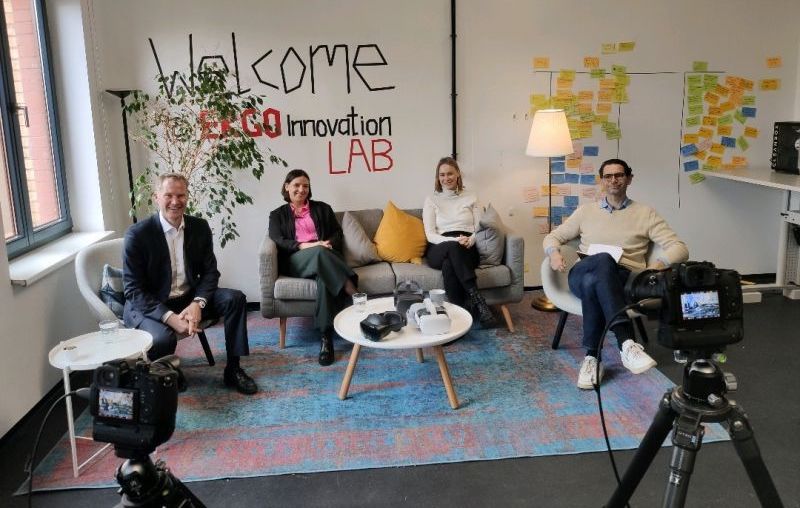
2 According to Capital, you are the only insurer among the top 10 most successful German corporate innovation labs. What role does your lab play in the ambitious 2025 vision, and what goals exactly are you pursuing?
Our lab has existed since 2013 and has developed over time into an important part of our entire digitalization unit, which has around 30 employees. In the lab, we look at new technologies early and think strategically about how they could be used in an insurance context, and at ERGO specifically. To do that, we start quite classically with ideation, conduct research into different technologies and assess what might be interesting about them for us. That is followed by target group and platform research, before we move on to first drafts and tests. For the testing, we develop small apps or first landing pages, or work with start-ups and agencies to build first prototypes, which we keep optimizing and track with relevant KPIs in order to gain learnings. Once technologies have proven themselves, we scale them as ERGO and roll them out across the group.
So the lab is almost like an incubator for new ideas and spin-ins. One example is voice assistance, which we first worked on in 2018. For that, we put together a large team with three specialist departments, two start-ups and 30 people, who spent a year working intensively on this technology. That is where our current conversational AI unit came from, whose phone bots take more than 10,000 customer calls a day in Germany.
Our lab's task has always been to look at how far certain technologies are and how we can make them usable for us as an insurer. As a lab, we stay flexible and agile in doing so, because corporate innovation always means movement and change. Through this continuous flexibility and this focus on concrete added value for our core business, we as an innovation lab secure our relevance in ERGO's corporate innovation process.
3 What exactly does your work in the innovation lab look like?
We work in a small team of five people. We each see ourselves as digitally minded generalists. Because the challenge with corporate innovation is that nobody knows what the big technological topic will be next year, or even in three months. That is why we decided not to hire specialists, but people who can do a lot, who take on a lot and who drive our projects forward independently. We extend our skills through internal resources from our specialist departments, such as the advanced data analytics team, and through external sources such as start-ups and freelancers. This approach allows us to work in an agile and broad way, with curiosity and openness to different topics being central.
Our goal is to try out ideas, initiate projects and, if they succeed, hand them over to the relevant specialist departments. But also, of course, to stop things when they do not deliver what we hoped for. In all of our projects we try to have a specialist department on board from the very beginning, so that ideally we can hand a project over smoothly. For that we usually set up an interdisciplinary project team with internal and external expertise. In the end, support and commitment from the entire management and from the specialist departments at ERGO are decisive for driving corporate innovation successfully and quickly.

4 Your "ERGO VR Experience" app has just won the Vordenker Award. Which projects and technologies are you focusing on at the moment?
At the moment my focus is very much on generative AI. Over the past year we researched this technology intensively and quickly saw that it will have a significant impact on the insurance industry. Among other things, we published a widely noted whitepaper to explore the strengths and challenges of AI for insurers as well as possible use cases. As an innovation lab, our goal is always to look behind the hype in order to find out where the productive plateau of a technology is.
In the AI field, too, we rely on a project team that works together with various departments, including advanced data analytics and conversational AI, and with relevant stakeholders on the "GoLLM" initiative. The point of it is to bring together the in-house expertise around generative AI and to develop solutions for using large language models at ERGO within the applicable legal and regulatory requirements.
Wondering what opportunities AI could open up in your company? Request an AI workshop now.
Wondering what opportunities AI could open up in your company? Request an AI workshop now.
5 What impact can GenAI have on insurers over the next five years?
Integrating GenAI into the insurance industry holds enormous potential, particularly when it comes to the use of large language models. Every day there are hundreds of thousands of customer touchpoints here where language has to be processed. That makes insurance companies predestined for the use of language models and the tools based on them. At ERGO we see GenAI in particular as support for writing tasks and as an alternative to ChatGPT, with security in the processing of our own data playing a central role. We view customer support and customer interaction in general as large potential fields of application.
But the insurance industry is also one of the most heavily regulated industries, which is why the use of the technology has to be carefully thought through and implemented. As ERGO, we are aware of the regulatory and ethical challenges that come with using GenAI in the insurance industry. Our data is often confidential and highly sensitive. Protecting it, and with it the trust of our customers, has the highest priority for us in the area of corporate innovation. That is also why we do not jump on every hype train just because it would be technically possible. And apart from that, we have had AI guardrails since 2019 that define how we use artificial intelligence here.
6 What is your approach to identifying new potential use cases?
Many roads lead to Rome, which means that with us, new use cases are identified sometimes in a structured way, sometimes opportunistically and sometimes purely by chance. Inspiration for projects can also come from internal team members, as was the case with virtual reality. A colleague brought the idea with him from a previous job. Generative AI, for example, came in through our trend scouting, which we use systematically to identify new developments. But many topics also come directly from our specialist departments or through the Tech Trend Radar, a joint publication by ERGO and Munich Re. It offers a comprehensive overview of technology-driven trends that will also affect the insurance industry.
Our typical approach involves continuous screening of technologies and trends, especially those that can influence the core business of insurers. Every team member in the lab is also required to spend at least two and a half hours a week going through external sources, whether magazines, podcasts or other media, in order to constantly get input from outside and spot emerging trends early. As an insurer, our main concern is to look at how technologies change risks and thereby affect our core business. Through this proactive approach we make sure that for emerging topics we have already gathered prior experience and a well-founded position on data protection, IT security and other relevant aspects. This combination of screening, exchange of experience and fast reaction time allows us to spot new topics early and respond to them quickly. So above all, we see corporate innovation as the ability to respond to opportunities with focus and a high level of commitment.
7 You originally come from market research. How important is continuous user research for developing successful innovation strategies?
Because of my training and my experience in market research, I still place great value on customer focus and on collecting user feedback. That gives me certain tools for defining what we want to find out and for generating research questions, which in turn form the basis for questionnaires and interview guides. Market research therefore helps me to systematize things, to make decisions and to give alternatives a clear direction. My researcher approach means that I always keep a certain curiosity and openness. And it means that with the right tools I keep pushing the customer's wishes to the top. But that is only one role in the team, it also takes many other skills and perspectives.
8 Large companies like ERGO are characterized in particular by structured processes. How do you make sure that a culture of openness to change is actually lived? Especially when tomorrow's opportunities risk getting lost in day-to-day business.
It always takes communication as equals to make sure that openness to change and corporate innovation are genuinely lived in a company like ERGO. Digital transformation requires employees to be closely involved from the start, their opinions to be heard and themselves to be enabled. Digital transformation never works by forcing it on people. At ERGO we therefore show exactly how technologies work, what their strengths and weaknesses are, what they can do and what they cannot. From the beginning, we communicate clearly and transparently what purpose the technologies we use are meant to serve and what added value they bring. That builds employee acceptance and takes away their fears. Because digitalization can only succeed with employees.
9 You have been working in ERGO's innovation lab for almost seven years. What are some of the most common reasons why corporate innovation fails, and what can be done about it?
I would like to turn that around and look at how corporate innovation leads to success in companies. From my point of view, that requires several key factors. First of all, clear management support is essential. Digital transformation must not only be wanted, it must also be actively lived by management. Goals such as digital leadership in 2025, in our case, play a decisive role here, because they set a clear frame for decisions.
Second, openness to different topics and a willingness to open up to external influences are decisive. We cannot predict the future, but we can actively shape it. And we can only shape it actively if we notice the things around us and let them inspire us. For that it is important that we think in an interdisciplinary way.
A third key factor is cooperation, whether with start-ups or with other external partners. The realization that we cannot develop everything on our own, and that doing so is not always the best route in terms of speed and agility, is decisive.
Fourth, a willingness to take risks, a healthy attitude towards mistakes and resilience are also important aspects. Admitting mistakes quickly is decisive here. What matters then is to learn from them and not repeat the same mistake.
Finally, fifth, careful measurement and management of KPIs is essential in order to understand when projects succeed or fail, and to remove barriers in good time. If a company lacks one or more of these elements, the risk of failing at corporate innovation is very high.
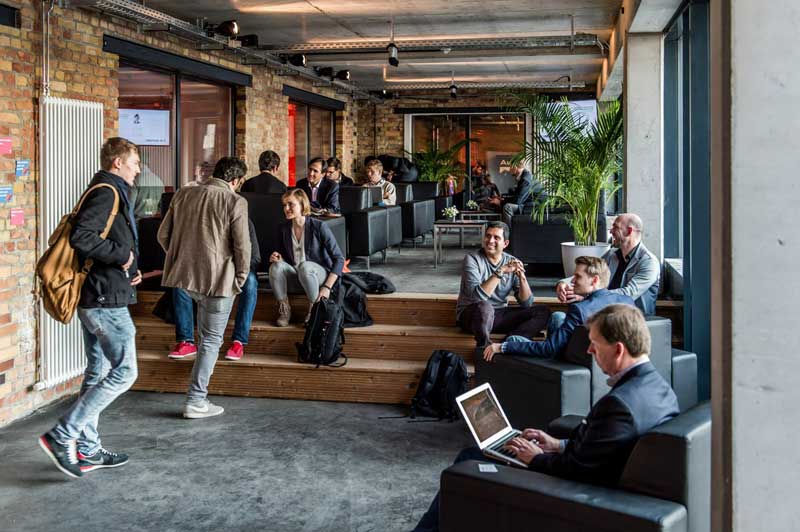
10 Your lab is not in Düsseldorf but quite deliberately in Berlin-Mitte. How does the collaboration with the local start-up scene and the various technology partners work?
The decision to be based in Berlin was made deliberately, both to be close to the start-up ecosystem in Berlin and to create a physical separation between the innovation lab and ERGO's headquarters. It has allowed us to actively put the concept of new work into practice and to be continuously inspired by our surroundings, before that became en vogue post-Corona. The focus is on being in direct exchange with start-ups and technology partners. Although we have also been working remotely more since the Corona lockdown, we continue to see the benefits of physical presence. It encourages targeted networking and the chance to meet potential cooperation partners.
Would you like to find out more about how we can support you on innovation spikes, for example with research and development or with the development of MVPs? Then take a look at our innovation services page.

Tech Newsletter
Join our 2,000+ subscribers and receive monthly updates on our latest articles, case studies, webinars, events, and industry news.