Artificial intelligence in the Mittelstand: how to save your competitive advantage

As part of digitalization, artificial intelligence is a key technology for the Mittelstand too. The rapid progress in generative AI in particular has made the subject considerably more important. Since AI is already being implemented successfully at numerous large German companies, this interview focuses on the opportunities and challenges that AI already holds specifically for the Mittelstand, the backbone of the German economy. We spoke about this with Dr Philipp Hartmann, Director of AI Strategy and Enablement at appliedAI, among other things about
- how to identify your first AI use case,
- how to increase your employees' and customers' trust in AI
- and what potential the available open source LLMs bring with them.
1 appliedAI has existed for 6 years and is Europe's largest initiative for the application of trustworthy AI technology in companies. What has changed for you since November 2022?
The most important aspect is that ChatGPT has made artificial intelligence something people can experience. ChatGPT has carried an understanding of AI to a broad audience. It also demonstrates vividly what AI can do. The flip side is that expectations are very high because of this hype, while the basic understanding is often missing. At many companies there is a reflex to want their "own ChatGPT" for their business. A language model like that based on AI can make sense as a knowledge base, but it does not yet answer the question of what I can and should do with AI. Because AI is much more than ChatGPT.
Since the beginning of the year, requests for AI consulting have risen sharply with us, particularly from companies that were previously somewhat further away from the topic. We notice that the Mittelstand, or companies that otherwise face less pressure to change, are engaging with the subject increasingly, and that an understanding of its relevance is already there.
2 AI is considered a highly strategic and transformative technology. What standing does artificial intelligence already have in the Mittelstand for digitalization?
More and more Mittelstand companies are coming to understand that artificial intelligence is a very relevant technology for the future. A typical question we often hear is: "what is the one AI use case that we can apply tomorrow and that will make us even more successful?" That one universal use case does not exist, of course. So there is catching up to do when it comes to knowing what transformative conditions a mid-sized company has to meet in order to use AI successfully. There are exceptions, though. Some companies, unfortunately still only a few, have already understood that AI in the Mittelstand is usually not something you simply place on top of something else. Rather, you have to think fundamentally beforehand about how this technology can create real value in your own mid-sized company.

3 In Germany many people are still sceptical about using AI. As a managing director or head of department, how can I increase my employees' and customers' trust in AI?
What matters is that mid-sized companies put AI on the agenda with the strategic relevance it deserves, because it has so many implications at so many different levels. The role of the management is central here: they have to lead the way and make AI a priority. As with many topics that bring change processes with them, it is decisive for success that the right mindset is created across teams. Because only when I fundamentally understand something do I lose my fear of it.
It is therefore important to offer internal training, for example, in order to give your own staff a basic understanding of AI beyond ChatGPT. It has also proven effective to keep explaining the AI strategy: where are we heading? Where do we stand? What developments are there? That is how those responsible successfully carry the subject of AI into the breadth of their mid-sized company and increase acceptance.
Of course there are also cases where artificial intelligence changes jobs and workflows considerably. It is in the nature of things that AI in the Mittelstand can optimise and automate many manual process steps. The only thing that helps here is honest and transparent communication about the effects and about possible changes.
4 Many companies in the Mittelstand still find it difficult to identify suitable AI use cases. What advice do you have for getting over this hurdle?
Even before you start with the first use case, we always advise looking first at what concrete potential AI holds for your own company. That does not have to be a three-month undertaking with a dedicated task force. A small core group is enough, one that examines your own AI ambitions and answers two key questions: how does AI in the Mittelstand change my business? And what are the big fields in which AI is relevant?
Once I have answered those two questions, I can look at what concrete use cases exist within that spectrum in my company, and which of them I can actually deliver. At the abstract level I then have to look at how much effort delivering that use case takes. So: how technically complex is it? How much data do I need for it? How much data do I have available? How far does the application have to be integrated into my system? And on the other side: what is my return?
My recommendation is to start with the use cases you can actually deliver as a company. But always with an eye on the overarching AI ambitions: where do I ultimately want to get to? The first AI use case should then sit in an area that is strategically relevant and has real business benefit. Otherwise you get stuck at the level of a pure showcase.
Wondering what potential AI could unlock in your mid-sized company? Request an AI workshop now.
5 Which major challenges on the road to a first use of artificial intelligence in the Mittelstand do you come across again and again, and what approaches do you recommend?
Many projects fail because of missing data or data quality that is too low. But there are many further challenges in AI projects. One thing that is always decisive: as a company you should build up AI skills internally as far as possible. If you have your own team for custom software development, you can enable that team on AI, for example. Or you build completely new skills in AI.
Delivering very complex use cases only with external service providers does not take a company further in the long run. Because AI models are never "finished" systems, you always have to develop them further over time and also watch in operation whether the model delivers the desired output. The question of how similar use cases might be delivered in other parts of your own mid-sized company also frequently requires an internal understanding of the technology. At the beginning it can of course still be very useful to start with an external partner who knows the field. But for the long-term success of large transformative projects, you should build your own ML team in the medium term where possible.
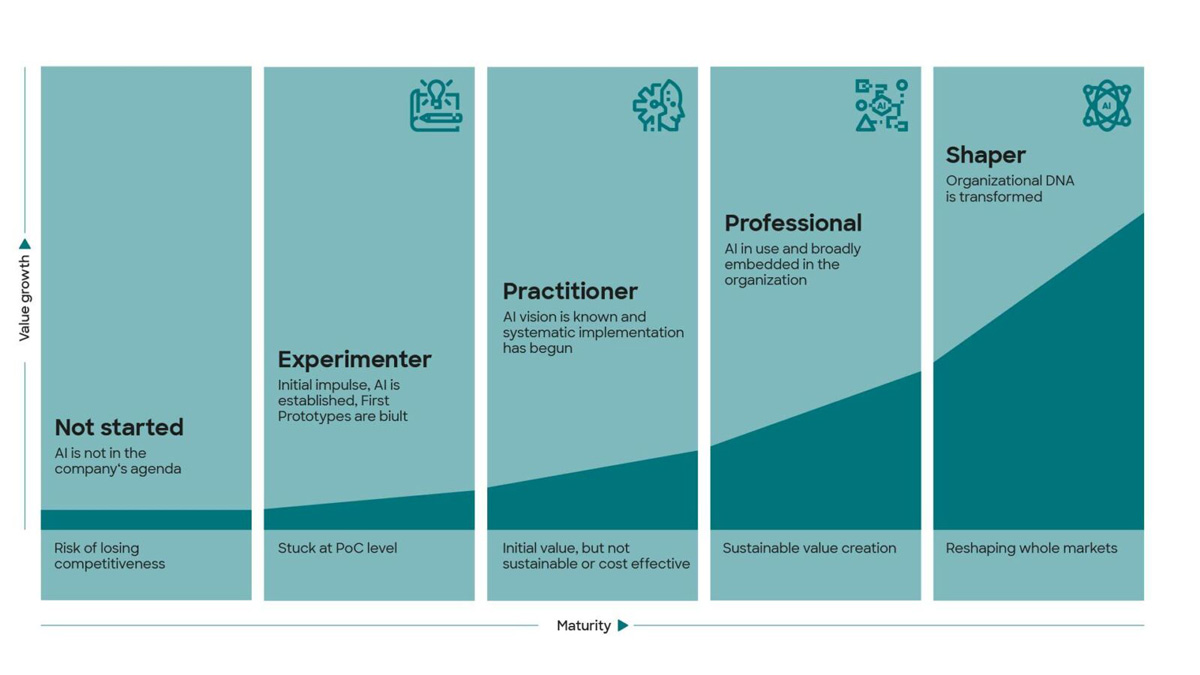
6 Data is central to using AI in the Mittelstand. What options are there for improving your own data quality?
It is very important to check right at the start whether the data exists and is of sufficient quality. After a short exploration phase it is often clear whether you can do anything with the data available. Depending on the use case there are of course alternatives too. But sometimes, honestly, it makes most sense to take a step back first and build up structured data.
Take predictive maintenance as an example: numerous failure records are needed here. But if you as a mid-sized company do not have enough failures because your systems run very stably, you should ask yourself whether that is really the right use case. So what matters is checking whether the topic you have chosen fits the data you have. Uncertainties should also be considered early, and you need the courage to discard hypotheses when they turn out to be wrong.
7 The decision whether to develop your own LLM or buy one is multi-layered. Which key aspects should companies definitely take into account in making that decision?
With language models there are various options. First, using the API of providers such as OpenAI without much additional effort. Second, using an open source model that can be adapted to your own needs with a little fine-tuning. And third, developing an entirely bespoke language model.
The decision depends on a few fundamental factors. Put simply: if a company does not have the skills and resources needed to develop its own language model or to adapt open source models to its own requirements, then those options drop out straight away.
At the same time, for the use of artificial intelligence in the Mittelstand, a company should ask itself strategically how important the output of a language model is for its own business model, and how strategic the data flowing into the model is. If the output is not particularly relevant strategically (standardised customer service enquiries, for instance), then an existing language model can be entirely sufficient for a smart customer support bot. For companies working with very sensitive data, on the other hand, such as pharmaceutical manufacturers, publishers with vast amounts of their own content or companies with a proprietary programming language for their own software solutions, it is important to consider whether that data should be fed into an external system where you cannot control what happens to it next.
8 How do you assess the open source LLMs currently available?
We have been seeing for some time that open source models are gradually catching up with current technological developments. With GPT-3.5, meaning the free version of ChatGPT, that has already happened. When it comes to reasoning problems, though, GPT-4 is still clearly ahead. For many classic use cases of artificial intelligence in the Mittelstand, such as summarising documents or retrieving knowledge in customer service, that GPT-4 level of language model is not necessary. So open source models already represent a very good alternative here.
9 Which possible AI-driven changes to business models should mid-sized companies have on their strategic radar in the coming years?
The first important realisation is that all AI topics have implications for the business model. How they play out concretely depends heavily on the industry. There are industries that are affected quickly and directly, such as publishing, because of the automatic creation of content. In other very specific technical industries, less changes at first, because AI does not change the core business model.
Every company in the Mittelstand should nevertheless ask itself what it already does very well today and what is relevant to its competitive advantage, but has the potential to be changed by AI in future. Process digitalization is the keyword here. Because if I compete with a manual process, however good it is, against an AI process, in pricing or trading decisions or in processing tender documents for example, I am always at a disadvantage, because I am always slower and therefore more expensive. That is why it is decisive to engage with exactly these questions early, in order to be prepared for the future.
10 How great are the chances of a German OpenAI? How do you rate the potential of Germany as a location?
That is a difficult question and I would like to be optimistic. In many areas there are companies making great efforts to move these topics forward. The speed and the resources behind it make it very difficult, though. ChatGPT is a good example of the incredible pace at which the field is being pushed forward: it took only five years from the first paper to a product used billions of times.
Even so, there are many areas where I see opportunities for Europe. One example is the industries that are traditionally strong in Germany, such as chemicals or mechanical engineering, which rest on value creation that requires many different components. There we are in an area that lives on the interplay between classic expertise and artificial intelligence. The goal has to be to enable these industries with AI so that they can take up competitive positions they can defend in the medium term.
At the same time you have to be clear that you cannot rest on the past and that companies have to move forward very seriously on artificial intelligence in the Mittelstand. The classic value chain will not help there. In the automotive industry we can already see that it is becoming difficult to hold your own with classic methods against companies that actively use AI. Not least, it is also of geopolitical importance that European companies do not become too dependent on a small number of foreign corporations, because I am convinced that we in Europe have to stay sovereign, in artificial intelligence as well.
Would you like to find out more about how we can help you as a mid-sized or large company with the design and delivery of AI projects? Then read on at our AI services page.



Tech Newsletter
Join our 2,000+ subscribers and receive monthly updates on our latest articles, case studies, webinars, events, and industry news.