From idea to app in eleven months: How Johanniter takes the load off family caregivers with SPRYLAB
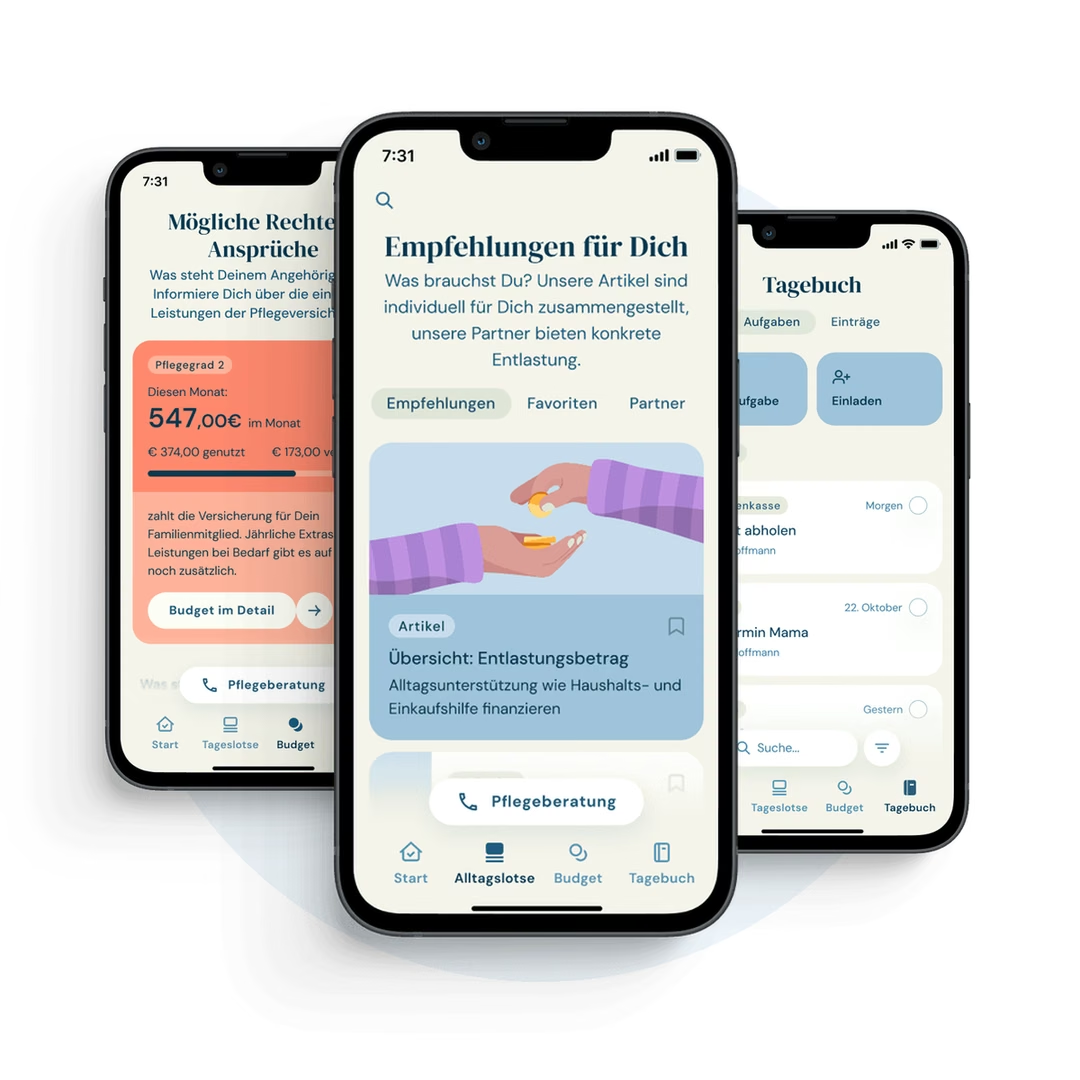
WeCare4JUH gGmbH is a wholly owned subsidiary of Johanniter-Unfall-Hilfe. With the mitpflegeleben app – an offering by Johanniter – it supports family caregivers in their everyday care routine.
Johanniter-Unfall-Hilfe
Leipzig
Long-term care
App development
About eleven months from project kickoff to go-live
Johanniter-Unfall-Hilfe is one of Germany's largest providers of outpatient care, operating around 170 outpatient care services nationwide plus inpatient facilities. Who it had not been reaching until then: the people who take on care at home themselves. Of the 5.69 million people in need of care in Germany, 86 percent are cared for at home, 3.1 million of them mainly by relatives.
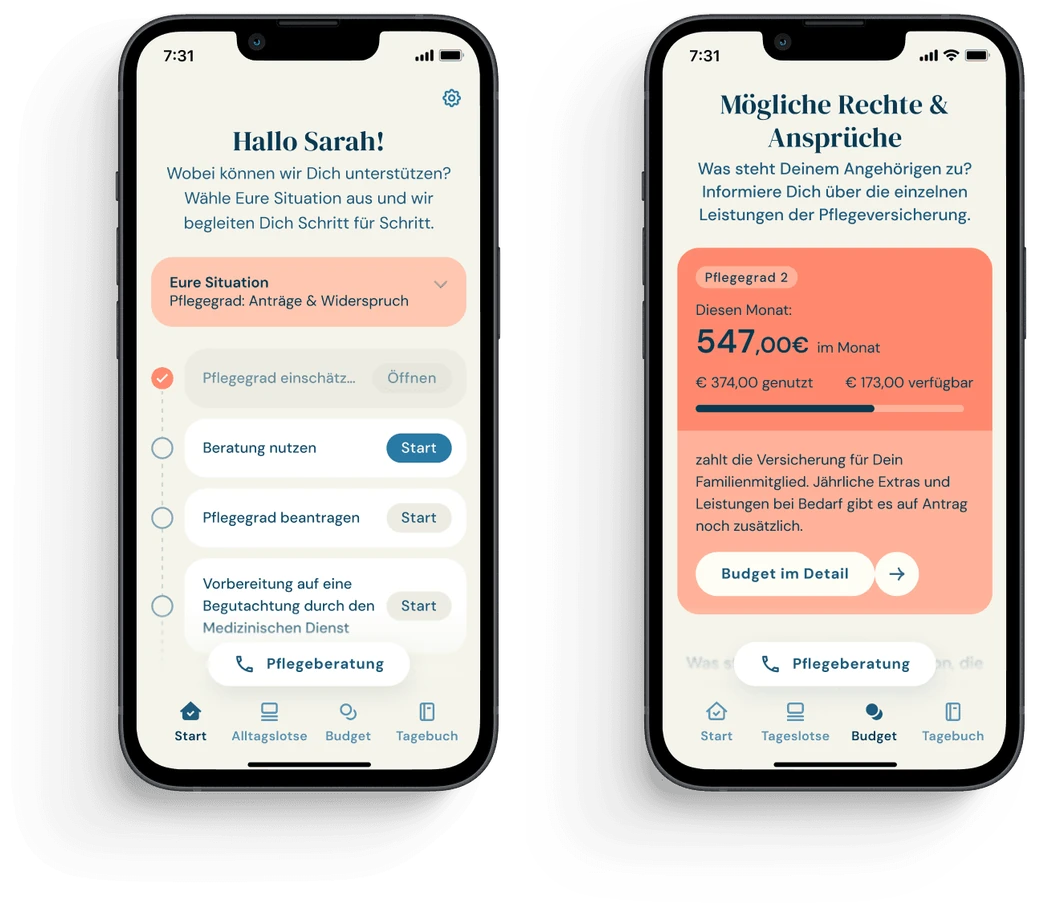
To reach this target group, Johanniter-Unfall-Hilfe founded WeCare4JUH gGmbH as a wholly owned subsidiary and, together with SPRYLAB, developed the app mitpflegeleben – an offering by Johanniter. In about eleven months from project kickoff to go-live, the team created an app that guides family caregivers step by step through everyday care: with the Alltagslotse (daily care guide) as situation-specific guidance, an overview of the available care budget, a diary for documentation and direct booking of services from Johanniter and selected partners.
The challenge: Millions of family caregivers Johanniter was not reaching
- Opening up a strategically untapped target group: family caregivers whom Johanniter had not been reaching
- No in-house software development, no development environment, no product team – and still getting off to a fast start
- Translating four core problems identified in target group research into concrete app features
- Building a digital offering that does more than an extensive Google search
- Securely processing the health data of family caregivers and the people they care for
- Choosing a technical foundation that will still be maintainable in three to five years
The care journey begins long before the first contact with a care service. This early stage had been a blind spot for Johanniter. People who care for relatives at home usually organize applications, budgets, appointments and aids on their own. Many only come into contact with the aid organization late.
“If we come into contact with this world earlier, we as the Johanniter brand are much closer to this target group,” says Till Walter, founder and managing director of WeCare4JUH, describing the strategic reasoning.
That is why development was preceded by a focus on this target group. For a year and a half, the team studied family caregivers, surveyed 200 of them and evaluated a study of its own. This resulted in four problem areas the app was meant to solve. One of them is feeling overwhelmed: there is an abundance of care information online, but nobody knows what matters first in their own case.
That set the bar. An app that merely bundles articles would not have justified the effort. Instead, every care task should be quicker to complete with the app than without it, for example by reusing data entered once for further steps. The team continues to work toward this goal. Internally, the project team summed up the objective in one phrase: the care advisor in your pocket.
The biggest organizational hurdle lay elsewhere. Johanniter lacked the technical expertise for a project of this kind. An in-house development team would have required recruiting, management and infrastructure before the first line of code was written.
“We know care, but not software development. SPRYLAB turned our care expertise into a product we could not have built on our own.”

The solution: An app that has to be faster than an extensive Google search
- App go-live about eleven months after project kickoff, without an in-house development team on the client side
- Four identified core problems translated into concrete features: Alltagslotse (daily care guide), care budget, diary, and finding and booking support services
- Six care situations as guided step-by-step journeys, from legal advance planning and care level applications to acute events
- Separate databases for content and user data: health data is stored in isolation, access-protected, on European servers
- An analytics setup that makes onboarding, key value moments, retention and referrals measurable in real time
- Editorial content with live preview: editors see their articles in the browser exactly as they will appear in the app
SPRYLAB won the pitch on value for money and readiness to start: a team that could get to work immediately. “The SPRYLAB project team was ready to go, with people who asked: What should we do first tomorrow?” says Till Walter. “Speed and expertise were decisive for us, and in the end it paid off.” The plan is also for WeCare4JUH to build up its own expertise over time while SPRYLAB gradually steps back. Until then, development capacity is called on when it is needed instead of being kept on standby permanently.
Developing the app in a separate company was a deliberate decision with a direct impact on technology. Within the association's structures, cloud and tool decisions would have gone through lengthy review processes. As an independent subsidiary, the team was free to choose. Accordingly, the requirements were lean: Azure as the cloud, otherwise proven and widely used technologies. What mattered was that the solution would still be maintainable in three to five years and that the developers were familiar with the components used. The app was built with Capacitor, a NestJS backend and Strapi as the content management system. The editorial team can open the entire app in the browser and check articles in their final layout before they go live.
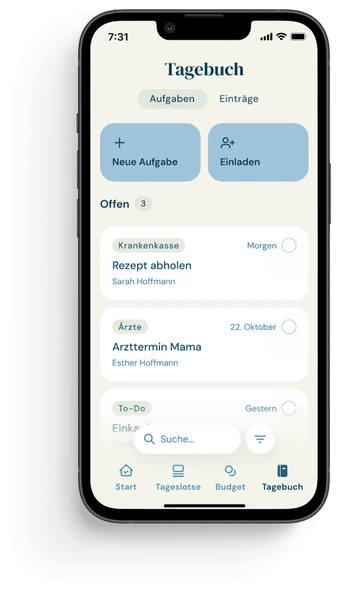
Because the app processes health data, SPRYLAB strictly separated data storage: a content database for editorial content and a separate, isolated database for user and health data. The diary shows how directly the features grew out of real needs.
Till Walter cares for his own parents and knows the situation from personal experience: he talks to his mother on the phone every day, and his sister should be able to see what was discussed. For situations exactly like this, the app lets users record visits, appointments and the person's state of health and share them with selected people.
The app deliberately does not use Johanniter's colors, because it is meant to reach a target group that does not yet know the organization. Johanniter nevertheless remains visible as the provider. This is what sets it apart from purely digital competitors: anyone looking for help via the app can book Johanniter services directly or get free advice by phone.
The biggest difference from a conventional app project is measurability. SPRYLAB instrumented the application so that product decisions can be based on data rather than assumptions. The onboarding journey is tracked in detail and adjusted with every iteration, a dedicated metrics system captures users' key value moments (articles read, tasks completed, documentation entries), and retention and referrals are tracked as well. PostHog serves as the analytics platform. “Today we can analyze in real time, draw conclusions and make decisions,” says Till Walter.
From the outset, the project was set up with clearly defined contacts on both sides and full transparency via Jira, sprint planning and sprint reviews. Till Walter highlights two points: reliability on schedule and budget, and the substantive role SPRYLAB takes on beyond pure implementation. “SPRYLAB is not a classic service provider that simply implements everything and sends invoices,” says Till Walter. “The team thinks things through with us and asks the right questions. We contribute our ideas, SPRYLAB takes them on and also challenges them, which I really appreciate. In the end, we have a solution we all really like.”
The results: 18,500 downloads in the first six months
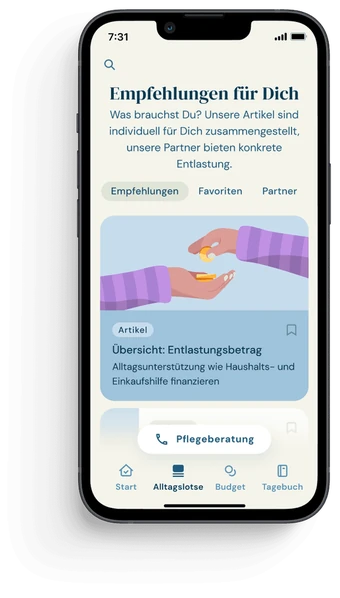
In the first six months since the launch of the marketing campaign, mitpflegeleben has recorded 18,500 downloads. The app is well rated: 4.7 stars on the App Store. The Alltagslotse (daily care guide) shows how the data-driven approach works. User feedback repeatedly expressed the wish for guidance through everyday care, because many people do not know what to do next. SPRYLAB built the feature, and the usage data confirmed the assumption: the Alltagslotse is used more intensively than other areas of the app.
Feedback comes from several channels: a focus group of around 30 family caregivers, interviews, App Store reviews and, above all, usage data. This makes it possible to continuously check whether an assumption holds, instead of building features and hoping for an effect.
Till Walter and Matthias Langer also draw a clear conclusion about the collaboration. According to them, deadlines, timelines and budgets were met throughout the entire project, without sprints in which commitments were left undone and without cost discussions after the fact.
The outlook: From information to real relief
The initial priority is growth. The app is free for users; the goal for the coming months is a larger user base. At the same time, the team is preparing for the Pflegeneuordnungsgesetz, a reform of long-term care in Germany. For mitpflegeleben, this shifts the focus: in future it will be less about explaining what a care level is and more about guiding family caregivers through the processes and taking work off their hands, for example when submitting an application.
“We develop with SPRYLAB at high speed and to the highest quality. Deadlines and budgets have always been met. What matters even more to me, though, is that SPRYLAB doesn't just implement, but contributes its own product thinking and asks the right questions. That is exactly how we will continue to work.”

Another area is the analysis of documentation. When relatives record over weeks how the person they care for is doing, a history emerges from which patterns can be derived. This is where Till Walter sees a meaningful starting point for artificial intelligence: capturing the overall situation and deriving preventive suggestions from it, rather than using technology for its own sake.
The model behind it is transferable. Johanniter-Unfall-Hilfe brings deep domain expertise, SPRYLAB the development expertise – each side contributes something the other lacks. The spin-off gave the project speed, flexibility and openness to technology.
Want to bring your digital idea to life? Get in touch.
Exciting, challenging platform projects are what drive us. If you’re looking for a technology partner to grow with, we’re the right fit.