Innovation through research: how knowledge transfer from institute to company works

Quickly integrating scientific ideas into everyday life, and responding to current challenges through innovative companies, is easier said than done. Not least because Germany is lagging behind in the forward-looking field of innovation through research when it comes to cutting-edge technologies and digitalization.
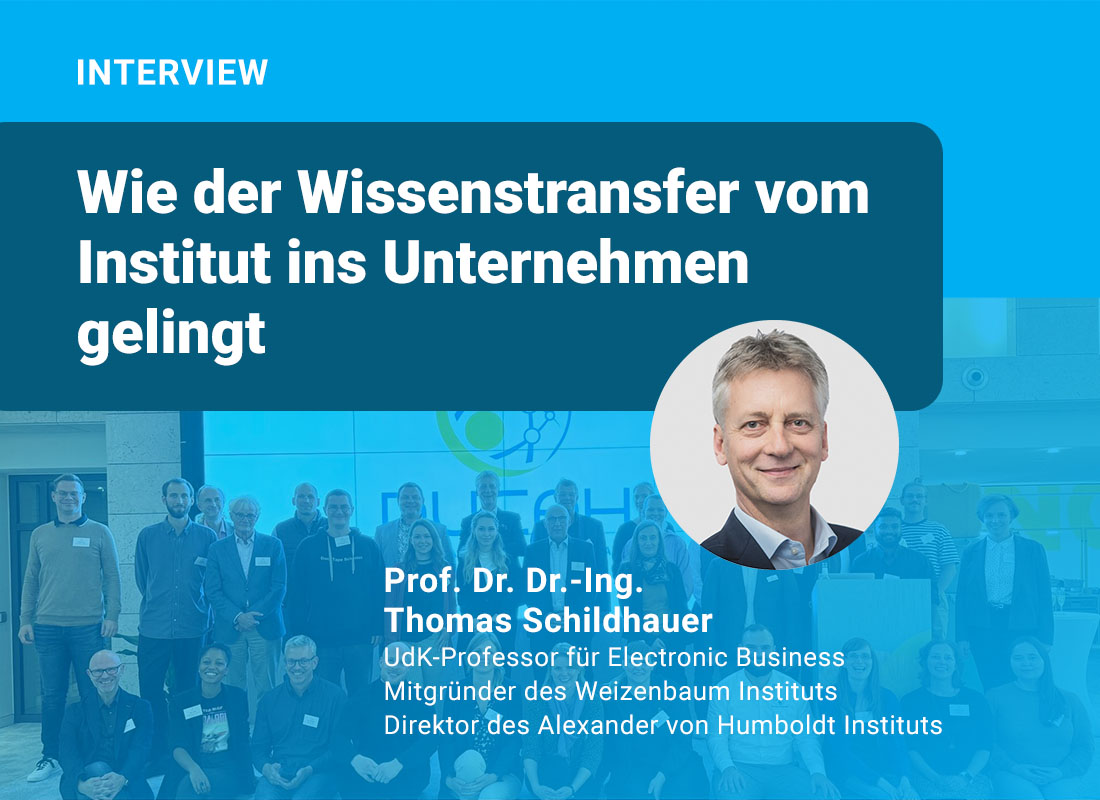
Prof Dr Dr-Ing Thomas Schildhauer is a trained computer scientist with many years of practical experience as managing director of Lufthansa Systems, professor at the UdK chair for electronic business, co-founder and principal investigator of the Weizenbaum Institute, director of the Alexander von Humboldt Institute and associated researcher at the Einstein Center Digital Future, as well as scientific director at the Digital Urban Center for Aging and Health (DUCAH) eG. We spoke with him on the overall subject of innovation through research, among other things about
- how knowledge transfer between science and industry works,
- how traditional companies can evaluate digital business models
- and how companies with very limited resources can benefit from the latest research findings.
1 Germany has traditionally had fairly strong research and innovation clusters. What role does research play for digital innovation in the German economy?
Germany is still placed in the top 20, and I see that as an important backbone of our future economic success. Because if we depend only on the (patented) innovation developed abroad, particularly in countries such as China whose political situation is uncertain, that is not a good basis for our German economy. It is therefore of decisive importance that we in Germany create a solid basis for innovation through research, by means of our own research efforts, securing patents and further measures.
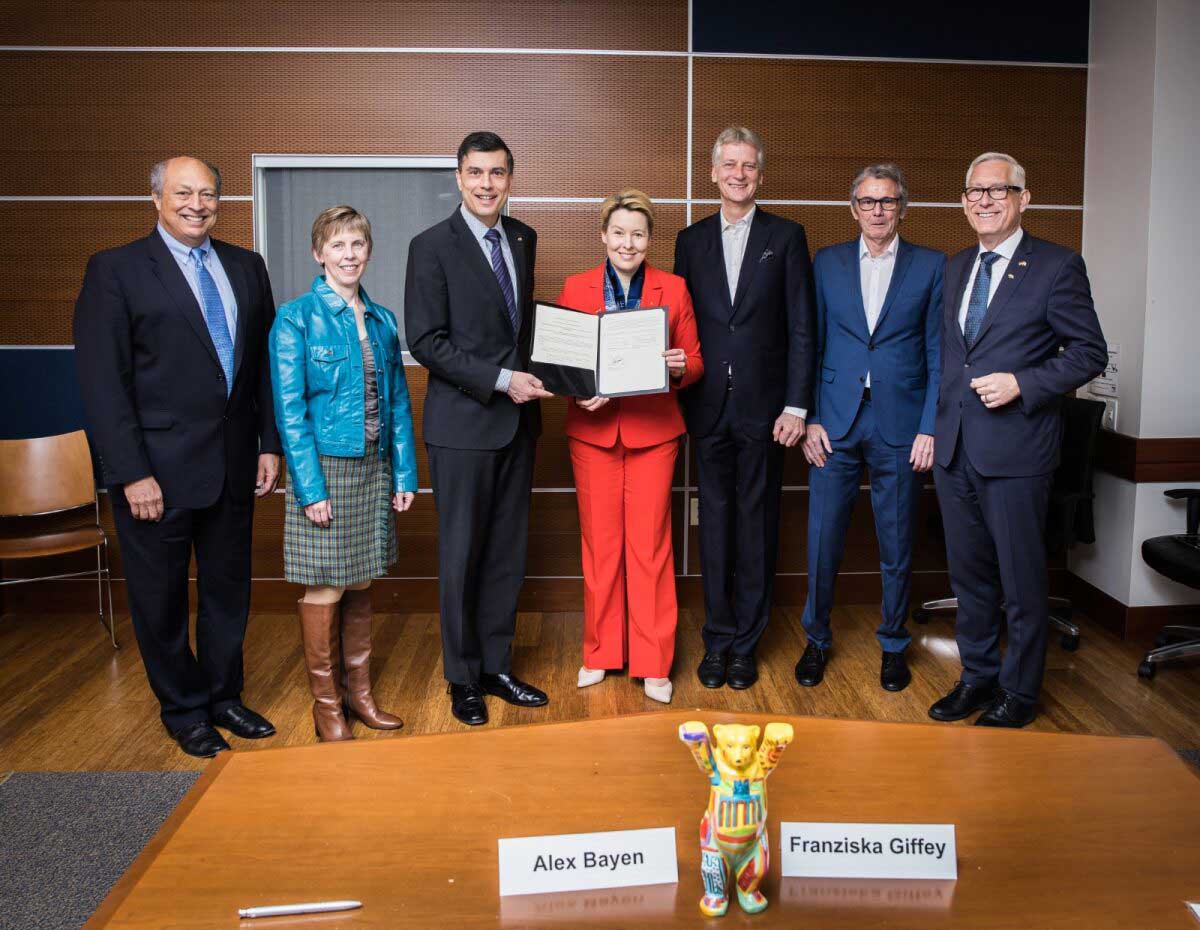
To hold that position, we have to build more alliances within Europe. Compared with countries such as China, we in Europe have fewer people working in research, but through targeted cooperation, European initiatives and research grants we can pool our strengths. As researchers, we are increasingly active in multinational projects. Partnerships with universities and organizations play an important role here, above all in North America. Personally, I work closely with Berkeley University in San Francisco. It benefits greatly from its strong innovation ecosystem, in which organizations, companies and venture capitalists reinforce each other. In Germany we still have some way to go in that respect, especially when it comes to shaping the transfer between research and industry. Partnership with American colleagues offers the opportunity here to create a substantive, innovation-driven space for that transfer and to gain strength for successful innovation through research.
2 You have supported numerous knowledge transfer projects in different areas. What do the particularly successful projects all have in common?
Successful transfer projects are marked from the very beginning by active participation from the companies involved. Particularly by them bringing their specific requirements and transfer needs into the research. In the area of problem-based basic research, it is decisive that questions from practice are properly reflected in the research. The successful projects dealt with fundamental questions, but combined with a precise problem definition and a clear awareness of the problem.
In my research work I have looked intensively in recent years at how innovation can be supported through research and how innovation projects can be led effectively. In doing so I came across the methodology of open innovation in particular. It holds that the more openly a mid-sized company, for example, enters a research project and allows external actors including market peers or competitors to be involved (coopetition being the keyword here), the higher the delivery speed of a project can become. Being able to draw on findings that have already been tested leads to faster development and more efficient use of the research and innovation capacity available in each case. Although this approach offers many advantages, there is still a need to explain it, because many companies have reservations and think that doing their own research gives them more of a competitive advantage. The idea of open innovation, which is often found in start-up cultures particularly in the US, emphasises the importance of openness, early feedback and fast iterations for an efficient innovation process that produces benefit faster for everyone.
3 Which example of successful collaboration between a research institution and a company has impressed you most?
An impressive example of fruitful collaboration between a research institution and a company lies in the area of social entrepreneurship. In this particular collaboration I worked together with students from my classes for various NGOs, including Deutsche Krebshilfe, Brot für die Welt, the Swiss Red Cross and UNICEF.
In some of the projects, the central challenge was to use social networks and the social internet effectively in order to increase people's willingness to donate. Smaller NGOs in particular often do not have the staff for this, because they usually operate as small and medium-sized organizations and use their resources on the ground for direct assistance. So in the courses we decided, for instance, to try out innovative approaches, chat technology and chatbots in particular, in order to use storytelling to explain to people which projects the NGO is delivering. That does not necessarily have to happen through a physical person on the other side, as long as it is still an interactive dialogue. Many typical questions can be answered by automated dialogue systems, which takes pressure off staff.
Through close collaboration between research and practice, we were able to use AI-based chat systems successfully for a good cause. The resulting improvement in explaining the NGO's activities shows how research can put new communication tools to sensible use in order to create benefit for everyone involved, from the donor and the person looking for information through to the NGO, which wants to communicate its work and its mission successfully and without using up resources. For me that is a fine example of innovation supported by research and teaching.
4 How can companies make sure they benefit from the latest research findings if they do not have the resources for research activities of their own?
Since I moved from Lufthansa Systems to the academic side, I have made it my life's work to promote this knowledge transfer. We have a large number of research institutions outside universities, including well-known names such as the Fraunhofer Institute, but also institutions such as the Institute of Electronic Business, the Humboldt Institute for Internet and Society and the Weizenbaum Institute, which are set up to give small and mid-sized companies access to research findings as well.
An outstanding example is the B-Co-Lab at the Institute of Electronic Business, a collaboration lab with organizations from the German Mittelstand, students from various disciplines and researchers. Here we take on innovation tasks from mid-sized companies and work on them over a semester of three to six months with a student team that is supervised and guided by someone with research experience. That offers a kind of extended workbench for applied research tasks that companies without a research department of their own cannot afford.
Beyond that we frequently submit funding applications within the network of the Digital Urban Center for Aging and Health (DUCAH), by bringing several mid-sized companies and social economy organizations together with the research institutions to work on a topic jointly. A current example is our projects under the BMBF funding programme on "AI in care", where we work and do research with organizations, start-ups, established institutions from the care sector, hospitals and research institutions in gerontology, medicine and data security. This approach allows small and mid-sized companies, as well as larger companies without research teams of their own, to take part in innovative developments and to help shape innovation through research.
5 How can established mid-sized and large companies manage to build an innovation culture of their own, or is that a contradiction?
Developing your own innovation culture in established mid-sized and large companies undoubtedly requires cultural change. It is decisive to think from the market inwards, to talk directly with customers, to understand their expectations and what they might like better at competitors. In the company, however, these discussions often slow down existing processes and day-to-day business.
In his well-known book "The Innovator's Dilemma", Clayton Christensen pointed out that work on innovation which leads to fundamental changes in business processes (process digitalization) should ideally happen outside the existing organization, in order to break free of established processes. That could be a subsidiary or a separate independent unit within the company. One example of this is the DUCAH cooperative, or the Berlin Institute of Health (BIH), an accelerator run by Charité that gives employees the chance to apply for projects and to work on innovative ideas for a certain period, released from their usual duties.
Across all industries you can see that it is decisive for corporate innovation to free employees from day-to-day business, or to give them the necessary room. Examples such as the Google model, where employees can reserve time for innovative ideas, or dedicated units such as a "digital solution" team in a mid-sized company that takes up and supports innovation ideas from across the whole business, show that approaches like these can work.
In my research, by the way, I have also looked at the factors that help and hinder the success of start-ups, in what are known as start-up clinics. In doing so I found that acquiring start-up teams into established companies often does not bring the hoped-for success. Start-ups are then frequently embedded into existing reporting lines and a hierarchical leadership culture, which can lead to frustration, the departure of the start-up founders and ultimately failure. That is why I prefer building innovation from the inside out, where companies bring teams in or invest in certain areas where they were not previously present. That often works better than simply acquiring an existing start-up team.
6 You were a lecturer on the MA in business innovation at the University of St Gallen for ten years and today are still a professor at the Berlin University of the Arts on the master's programme in leadership in digital innovation. Which skills do you teach your students so that they can help shape the transformation into the future?
Working with NGOs, including the Swiss Red Cross and UNICEF Switzerland, we asked the students in teams to work on pressing innovation challenges for these organizations. Each team, made up of four or five students, was given a methodological basis in open innovation development or in the lean start-up process in order to tackle the task set within one semester.
Since the University of St Gallen is particularly strong in business models, we also looked at developing sustainable business models for NGOs, in order to make sure that the ideas developed are viable in the long term. As an NGO you do not want to make profits, but of course you do want to find a way to run and continue the whole thing. The students greatly appreciated this hands-on application of knowledge from the master's programme for a good cause, and I am firmly convinced that this is an effective way to promote innovation through research as early as the master's degree.
7 What do you advise more traditional companies that want to evaluate new digital business models?
When assessing new digital business models for more traditional companies, I recommend moving quickly to testing the idea. It is decisive that the company works with the market and with customers early in order to develop and refine the idea. The critical moment comes when the company sets a price and the exact scope of services for the business model, and it is advisable to do that relatively early. With digital business models there is of course also the option of pursuing a freemium to premium strategy, by first bringing the model to market free of charge in order to test how it works. Once a certain tipping point is reached, you can then switch to a paid premium model. Although that comes with higher risks, it still offers an alternative way forward, in contrast to an approach in which the business model is tested on the market at a fixed price at an early stage. Both options are workable with digital business models, however.
8 As part of your work at the UdK Berlin and the Einstein Center Digital Future, you co-initiated DUCAH. What is the mission of the Digital Urban Center for Aging and Health?
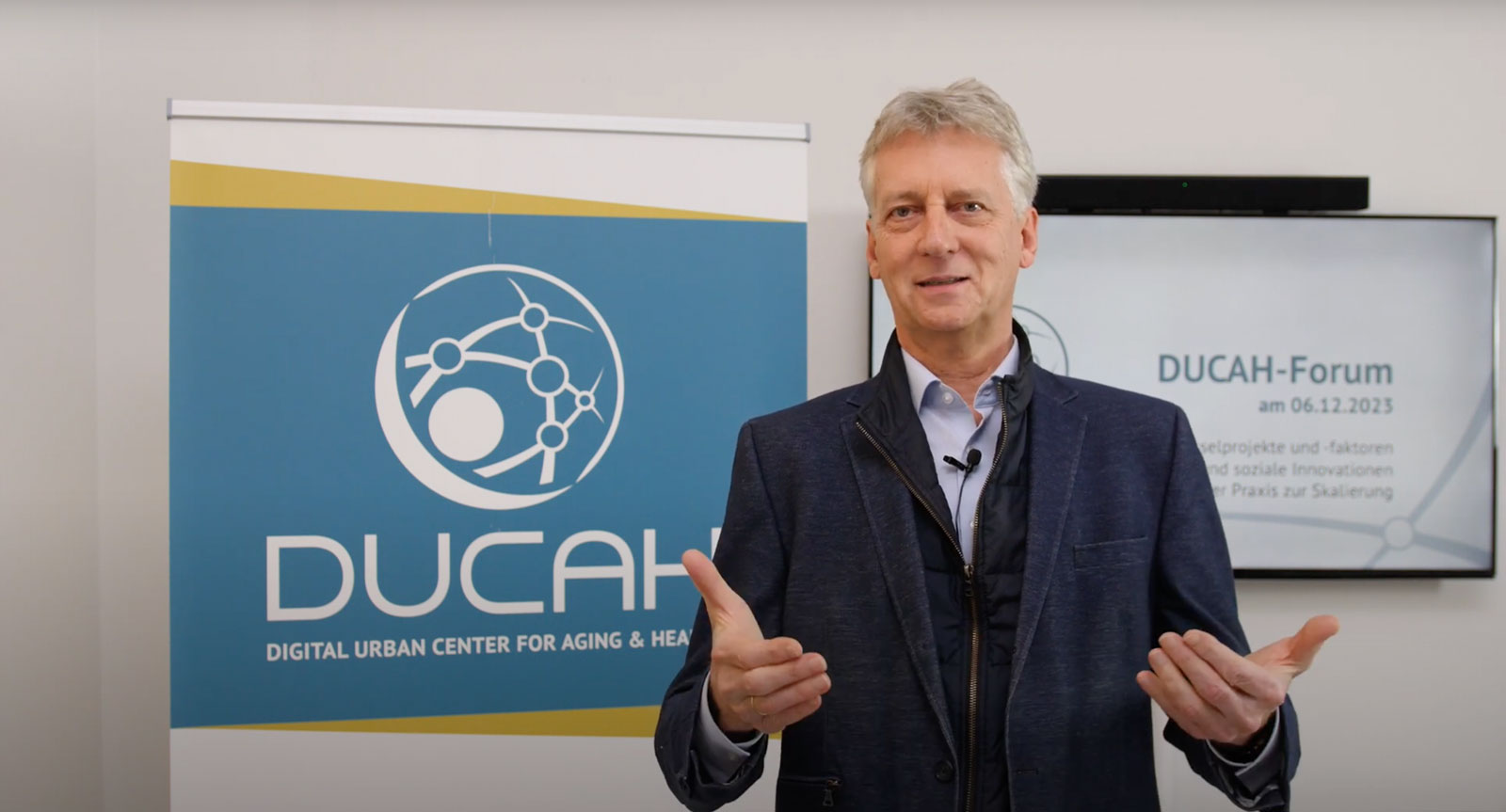
The basic mission of the Digital Urban Center for Aging and Health (DUCAH) eG is to bring digital innovation in health successfully to the people who work in this sector, and to make sure it is taken up in the market. The focus here is particularly on keeping projects alive after their funding phase and supporting their sustainable delivery and use. DUCAH relies on a multidisciplinary approach shaped by experts from various fields such as business administration, law, the social economy and design. The centre provides feedback during field testing of innovative ideas, supports projects in the market and promotes market access, including scaling solutions up.
Under the heading of "DUCAH innovations", DUCAH brings together teams that address the challenges facing social enterprises. This open innovation process involves team building between start-up teams or solution providers and social enterprises. Through coaching and an iterative process over three to six months, the aim is to support solutions that can gain a foothold in the market successfully and that are financially affordable for social service providers and for end users.
This holistic approach aims to make the research strength and expertise from various institutes usable for the social economy and thereby make a real contribution to the challenges in the health sector. At the Einstein Center alone we now have more than 40 endowed professorships across all disciplines. At the German Internet Institute, the Weizenbaum Institute, which I co-founded, another 120 researchers work and there are four additional professorships. On top of that comes the international perspective we bring through the Humboldt Institute for Internet and Society, as part of a worldwide "Network of Centers" that we built up. All of that strength, and that was my basic idea, we want to bring to bear for the social economy, where digital innovation through research creates real benefit.
9 Where do you see the biggest opportunities of digitalization for the social economy?
I see a very big opportunity in taking pressure off care staff. One concrete example is recording hours and documenting services, which can be improved through voice-to-text solutions, so that care staff have more time for direct personal attention. A further perspective is to use digital support to allow people to stay longer in the social environment they are used to. The acute shortage of care, caused by a lack of care staff and care home places, is a major challenge for society. Designing future residential property and integrating smart devices, wearables and monitoring solutions play a decisive role in this, both for new buildings and for revitalising existing property.
Beyond that, AI is being used in health as a preventive instrument. Machine learning can support a wide range of preventive measures, with first promising approaches already existing in the areas of diabetes, rheumatism, dental health and heart health. The possibility of keeping people away from medical or nursing care for as long as possible with the help of good support systems, or of supporting that care better where it is necessary, holds enormous potential that can be used effectively as digitalization advances.
Do you have first AI ideas in mind but are not sure whether they make sense or are feasible? Request an AI workshop now.
10 You spent many years in industry, working for Atos and Lufthansa Systems among others. In what way do you benefit from that experience in your current positions?
Long experience in industry is significant capital for me, because it obviously means I bring a deeper understanding of the practical requirements and conditions in which companies operate. At Lufthansa Systems in particular I learned how important it is that university graduates can work flexibly in interdisciplinary teams, not only in their own field but in others too. It is no longer enough for computer scientists to be able to program; they need a broad understanding of business, they have to understand users' needs, have design and user interface skills and have insight into business models and processes. I have consistently applied these insights in my work in education and research ever since.
Would you like to find out more about how we can support you in the field of technology innovation, for example with research and development or with the development of MVPs? Then read on at our innovation services page.

Tech Newsletter
Join our 2,000+ subscribers and receive monthly updates on our latest articles, case studies, webinars, events, and industry news.