Digitalization at a family business: the approach that works at Melitta

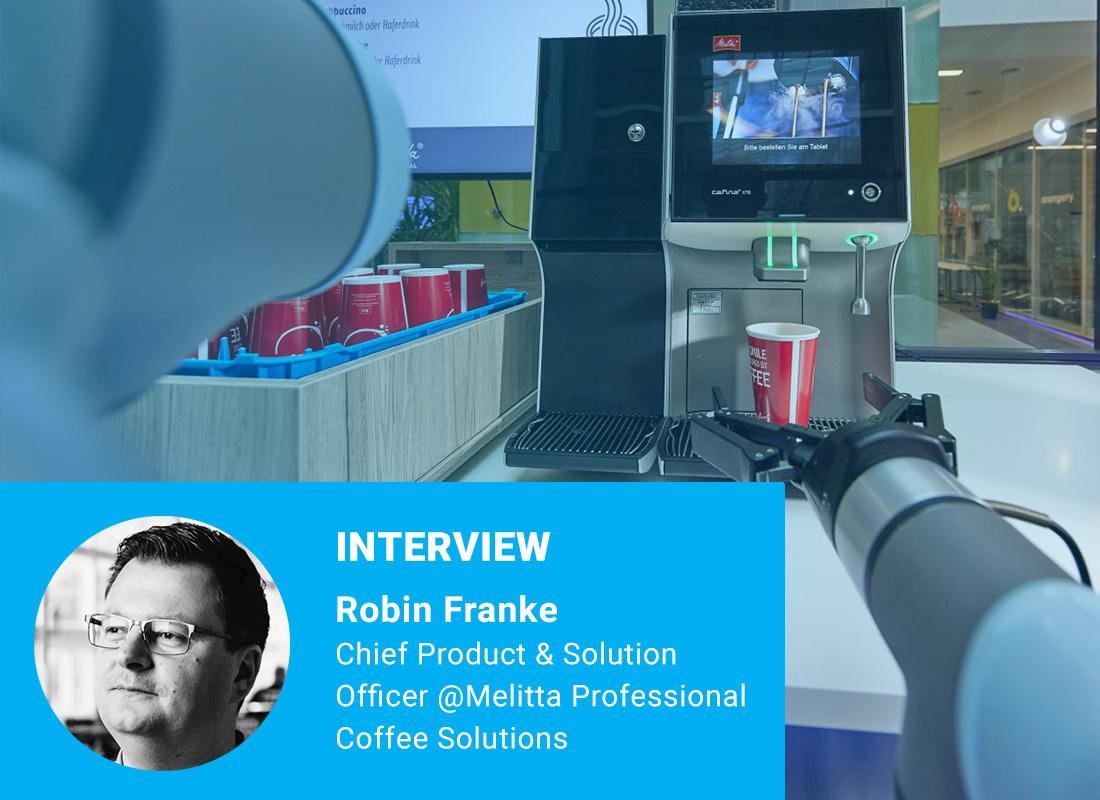
Whether in restaurants, hotels or food services, expectations of professional coffee preparation are changing rapidly. It helps that innovation has played a central role in the digitalization of the family business Melitta since its founding. Over recent years, Melitta Professional, the part of the Minden-based company responsible for professional coffee preparation, has steadily expanded its digital infrastructure with an intuitive customer portal as the entry point, an IoT hub as its backbone and numerous interfaces. Plenty of reasons, then, to talk to Robin Franke, Chief Product and Solution Officer at Melitta Professional, about
- analysing data from more than 45,000 connected coffee machines,
- the potential of personalisation and automation in the customer experience
- and managing requirements across different global markets.
1 What are your goals and tasks as Chief Product and Solution Officer at Melitta Professional?
My mission is to help our customers find integrated solutions and thereby make full use of Melitta's strengths. Within my area of responsibility I lead various teams focused on machine development, coffee for the B2B sector, service, the digitalization of the family business (current focus: insights, payment systems, user interfaces), customer solutions and sustainability.
Ultimately it is about offering our customers more than just coffee machines. We want to create real value and therefore offer a comprehensive package of consulting services. That ranges from choosing the right coffee through tailored service concepts or rental models to coffee tastings and quality audits. We rely on individual solutions that put our customers' needs at the centre.
We used to think very much from the machine outwards, but the machine is only part of the answer. Solutions, for me, means that we see ourselves as enablers and keep extending our toolkit of solutions in order to improve the entire customer experience. Our methods, such as the solution board and the approach of always thinking from the customer inwards, help us identify problems specifically and develop individual packages.
2 Melitta is a company with over 100 years of tradition. What standing do innovation and digitalization have for the family business?
Melitta has a 115-year history. Without innovation the company would no longer exist at all. So continuous development and renewal are always relevant. In today's world, digitalization is an indispensable part of that innovation process. Innovation is the driver, and if that innovation is digital, then so be it.
For us, digitalizing our family business is not only a means of increasing efficiency, it also gives us a better understanding of our customers. Beyond that it can simplify the work of our technicians and our administration as well as access to our products and information.
We also encounter challenges, though, particularly in operationalising our insights platform and in the change process that comes with it. We now collect a lot of data from our coffee machines, but operationalising these insights so that they quickly create value is challenging.
3 Three years ago you created a central entry point into the digital world of your coffee machines with the cloud-based insights customer portal. What do your customers particularly like about it?
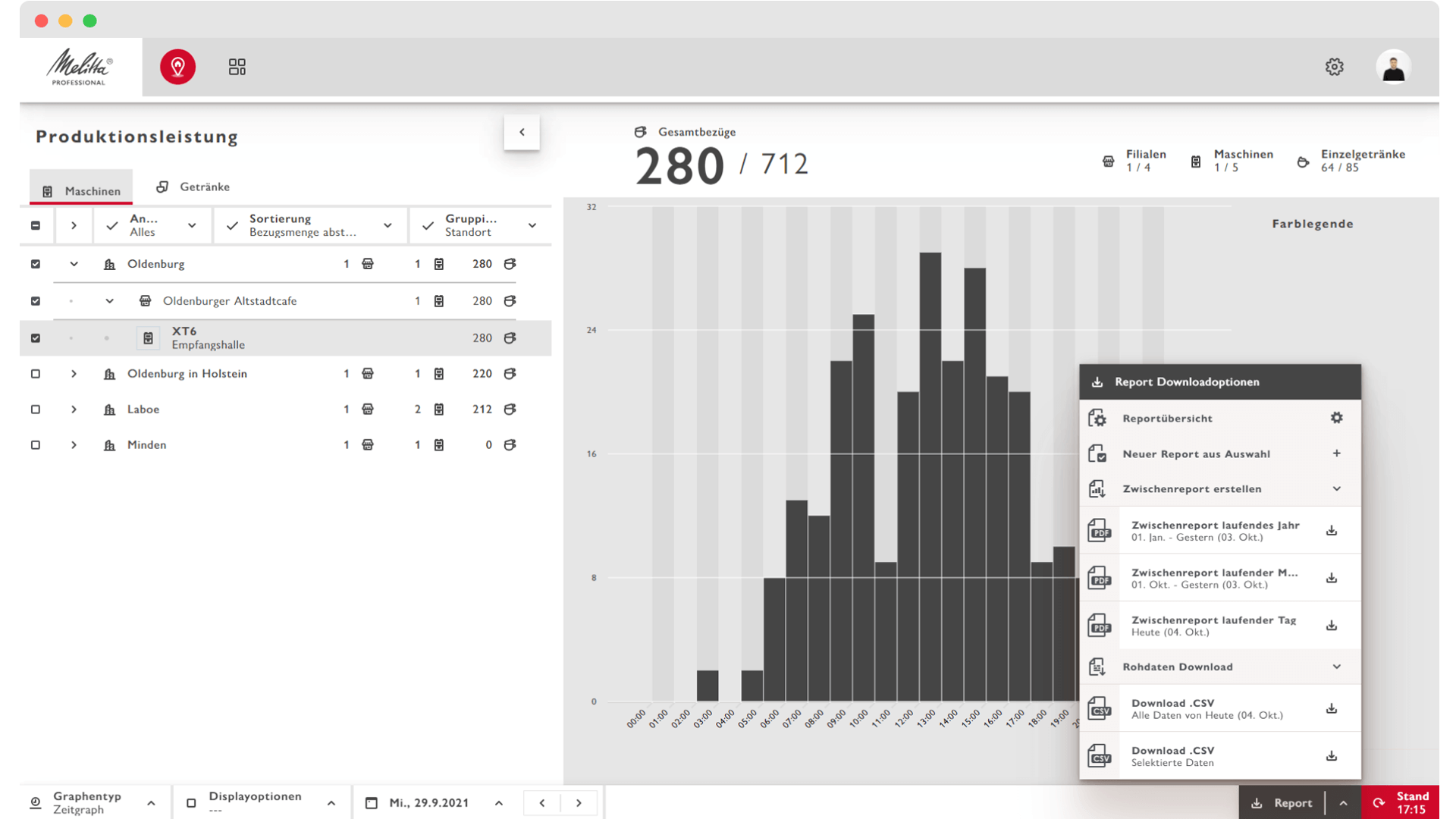
The cloud-based insights customer portal that we introduced three years ago was a decisive milestone in the digitalization of our family business and has already proven itself as the central entry point into the digital world of our coffee machines.
What our customers particularly appreciate is the fully visualised frontend approach. Although from a technical point of view it actually provides comparatively little information, it gives our customers an easily understandable overview of how their machines are performing. It is precisely this deliberate focus on the perspective of our mid-sized customers that goes down very well. And for anyone who needs more detail, we can always help with our API.
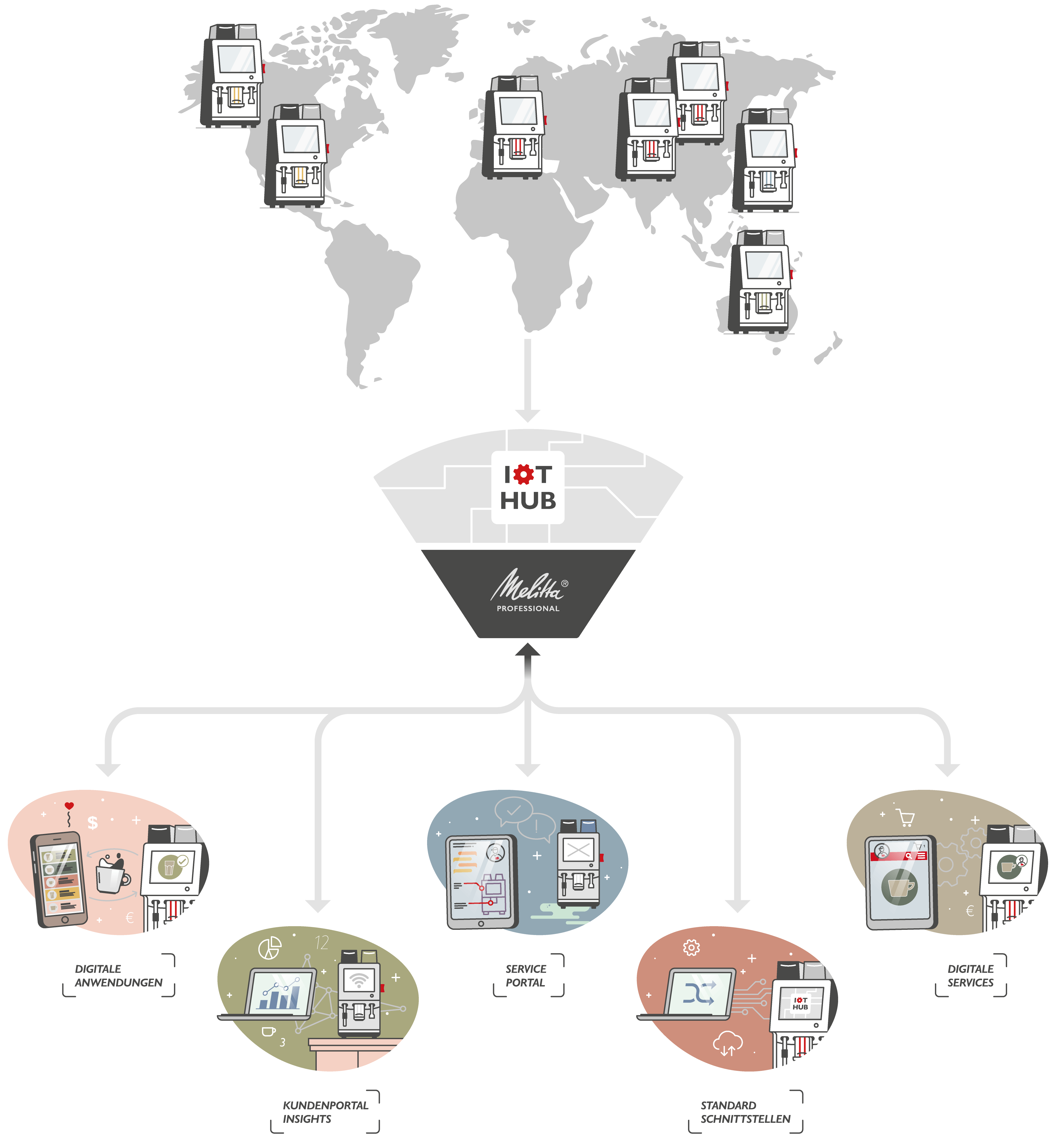
4 Your own IoT hub connects more than 45,000 coffee machines, and a single fully automatic machine now has 150 data points. How do you make sure meaningful insights can be derived from this volume of data?
We are still right at the beginning of analysing this rich dataset systematically. At the moment we mainly use the data points we collect in problem cases, but we also see great potential for the future. We imagine using the data ad hoc in future to solve machine problems quickly, ideally in a call centre dispatch scenario.
We also plan to analyse data systematically in order to determine the overall performance of a customer's coffee machines, or even to measure the performance of specific components. The challenge for us is to identify the relevant questions and to think about how we can make the data effectively accessible. So our focus in digitalizing our family business is not only on the data itself, but above all on how we can build it into meaningful services for our customers.
5 AI and IoT keep converging. How do you assess the potential of AIoT for the hot beverage industry?
The potential of AIoT for the Mittelstand as a whole and for the hot beverage industry is enormous. Of course it depends heavily on creativity and on applying it in a targeted way. AI could be used in beverage development to generate innovative suggestions, for example. There are limits, though, since AI is currently not able to taste. Even so, it is possible to feed AI with specific data and use it in a targeted way in our field. In future, AI could learn to understand the flavour profiles of coffee varieties and the tolerances in machine settings, in order to give customers personalised recommendations.
What is decisive, though, is identifying the relevant questions and teaching the AI the corresponding information. And this still applies: AI can reveal patterns, but interpreting them remains a human responsibility. Although the potential is huge, I still do not see AI as the most important next step for the digitalization of our family business, or for my industry in general.
6 You are an advisor to the Swiss IoT start-up Veetamine. What is special about the solution?
Veetamine is a kind of translator hub for the internet of things in the coffee machine sector. Given the large number of coffee machine manufacturers with their own IoT solutions, and operators using machines from various manufacturers, the challenge is to integrate and synchronise the different machine models in a single dashboard.
Veetamine gets over this hurdle: it brings different fully automatic coffee machines together in a shared cockpit and at the same time offers an interface to the customer's ERP system. Veetamine therefore builds a bridge between various device manufacturers and system providers, with their different naming conventions and data interfaces, in order to make it easier for customers to use their data meaningfully.
7 Customer preferences and expectations are changing at breakneck speed. What makes an excellent customer experience in chain catering?
State-of-the-art customer experience in chain catering is strongly shaped by the fast change in customer preferences and expectations. The focus at the moment is on creating convenient and quick access for consumers. Automation plays a key role in areas such as payment systems, preparation and beverage dispensing. Another big topic is the degree of personalisation and attention to individual circumstances or the time of day, for example.
Accessibility and transparency are therefore central aspects for customers, while providers aim to offer the broadest possible range and individual solutions in order to create new experiences of use.
There is qualitative improvement in the cup itself too. Here technology is used to improve and shorten processes. The customer experience emphasises both tailored preparation for the individual customer and impressive automation in making the drink. The goal is to give customers the feeling that the drink is being prepared specifically for them, but without preparation that takes time. And for the operators of the systems, the aim is to use automation to reduce, if not entirely avoid, all everyday effort.
8 How do you make sure your digitalization strategy meets the cultural and legal requirements of the various global markets?
Meeting the requirements of the many different global markets is almost impossible for us. We work with an experienced consultant here in order to navigate the complex jungle of rules, whether on data protection or tax law. The various legislators do not exactly make it easy for us in digitalizing our family business, so we invest heavily in building comprehensive knowledge for different countries, regions and business segments.
These efforts require not only thorough research but also practical experience. Being able to adapt quickly to new customers from different countries is one of our strengths, and we always aim to work very conscientiously and to take as many country-specific details into account as possible.
9 Sustainability is becoming more and more important. To what extent can technology already help enable more environmentally friendly production processes, packaging and disposal methods?
Digitalization clearly helps us act more sustainably. Efficient digitalization of our family business can avoid field visits by technicians, for example, which makes an important contribution to sustainability. In production, digitalization allows processes to be streamlined, when it comes to optimal packaging solutions for instance.
It is important to note, though, that digitalization can also cause emissions. As a company we always aim to identify the biggest lever for sustainability. As in other areas, the same applies here: digitalization only makes sense when it creates clear value and is not pursued as an end in itself.
10 You have worked with coffee preparation professionally for 16 years. What is more important for successful digitalization projects, experience or passion?
Everything is easier when it is fun, in any case. While experience is certainly useful, it can occasionally be limiting too. In some cases a certain lack of preconceptions about a subject is decisive, because it encourages the courage to take on challenges that look insurmountable. Ultimately a balanced mixture of experience and passion is probably the key to success in digitalization projects.
Would you like to find out more about how we can support you with digitalization or in innovation, for example with research and development or with the development of MVPs? Then read on at our innovation services page.

Tech Newsletter
Join our 2,000+ subscribers and receive monthly updates on our latest articles, case studies, webinars, events, and industry news.