Process digitalization: your route to a successful transformation


Process digitalization means the future. Whoever masters it will handle the economic challenges of our time successfully. Because digital processes are not only less error-prone and more cost-efficient than analogue procedures. They are also the precondition for using new technologies such as artificial intelligence and thereby securing your competitiveness. But according to the digitalization index, German companies are still far from making the most of the benefits of digitalizing their processes. Time to change that.
In this article I show you why you should invest in your process digitalization now and where it is best to start. I answer the most important questions about getting started and give you our best practice roadmap, so that you can drive your company's digital transformation forward decisively.
Prozessdigitalisierung bedeutet Zukunft. Wer sie meistert, wird die wirtschaftlichen Herausforderungen unserer Zeit erfolgreich bewältigen. Denn digitale Prozesse sind nicht nur fehlerfreier und kosteneffizienter als analoge Vorgänge. Sie sind Voraussetzung, um neue Technologien wie künstliche Intelligenz einzusetzen und so die eigene Wettbewerbsfähigkeit zu sichern. Doch laut Digitalisierungsindex nutzen deutsche Unternehmen die Vorteile, ihre Prozesse zu digitalisieren, noch längst nicht optimal. Zeit, das zu ändern.
In diesem Artikel zeige ich Ihnen, warum Sie jetzt in Ihre Prozessdigitalisierung investieren sollten und wo Sie am besten starten. Ich kläre die wichtigsten Fragen rund um die Einführung und gebe Ihnen unsere Best Practice Roadmap an die Hand, damit Sie die digitale Transformation Ihres Unternehmens entscheidend vorantreiben können.
- Definition: how we understand process digitalization after 17 years in the market
- Without process digitalization, companies lose competitiveness
- The biggest opportunities of process digitalization for mid-sized and large companies
- Which processes are particularly well suited to digitalization?
- Five steps to digitalizing your processes successfully
- Standard software versus custom development: what suits when?
- Our 6 most common use cases: where process digitalization pays off most
- Challenges that should not discourage you
- Conclusion: process digitalization as the basis for future viability
- FAQ: frequently asked questions about process digitalization
Definition: how we understand process digitalization after 17 years in the market
Before I come to the practical questions of process digitalization, let me establish a shared understanding of what we are actually talking about.
Processes are the heart of a company. They describe a sequence of activities carried out to reach a particular goal, and they take place every day in every company, whether in invoicing, requesting leave or processing orders. The complexity of processes varies widely and can range from a few steps within one department to sequences spanning an entire group with numerous people involved. Process digitalization is correspondingly varied in how demanding it is.
Example: a leave request. Many working steps, one process. To request leave, your employee first marks the days they want in a digital tool. Ideally the team lead is informed automatically, checks the period and approves it if nothing speaks against it. With one click the team lead triggers a notification to HR so that the leave can be documented. Where relevant, the team calendar and the time tracking tool are updated with the leave information as well.
What is process digitalization?
Process digitalization means using digital systems and applications to improve business processes. Unlike process automation, where individual and usually already digital process steps are automated, process digitalization is about digitalizing processes as a whole. Paper documents are not simply reproduced in digital systems. At best, processes are rethought and data capture, analysis and processing are improved using digital possibilities, so that results are achieved faster, costs are saved, collaboration is simplified and better decisions become possible.
Over the past 17 years in the market, we have delivered numerous process digitalization projects successfully. The fundamental steps are the same each time, but the existing systems and requirements differ in every company, and that is exactly where the challenges lie. Putting process digitalization off because of that cannot be a sustainable solution for you, though.
Without process digitalization, companies lose competitiveness
Germany is better than its reputation when it comes to digitalization. The European Commission's DESI index measures the maturity of digitalization in a European comparison. On the business-related indicators, Germany sits in the middle of the field. That is not enough for the international top tier, though. If your company wants to grow or expand its market position in future, you have to make full use of the opportunities that digital technologies offer. Otherwise massive economic disadvantages loom.
- Lack of efficiency: process digitalization delivers speed and efficiency. If your company does not use AI and automation to optimise its processes for productivity and customer service, it will lose out in the medium term to competitors that do use new technologies. It acts more slowly and cannot create the degree of personalised customer experience that forward-looking competitors achieve.
- Higher costs: analogue processes usually involve a lot of manual time and staff effort, which drives operating costs up. They are also more prone to human error, which can trigger direct and indirect costs as well.
- Lack of flexibility: when you use digital processes, they can be restructured with a few clicks. Manual processes, by contrast, are more sluggish. Restructuring them takes more effort, which makes it harder for your company to stay competitive in the face of greater uncertainty and market dynamics. You need more time to make necessary adjustments and cannot use the advantages that industry pioneers benefit from.
- Poorer decisions: complex markets can hardly be analysed effectively any more without digital support. AI systems are clearly superior to people in the retrospective and forward-looking analysis of data. If your company digitalizes only a few processes, it cannot make full use of the advantages of AI. That creates tangible disadvantages, because you have to keep basing your decisions on experience and intuition and are therefore working with the poorer navigation instruments, since they are less forward-looking and less reliable
Digitalizing processes belongs right at the top of your company's agenda if it does not want to lose out in future. Most German companies are aware of how important process digitalization is: in a representative Bitkom survey in 2023, 87% of participants said that using digital technologies is decisive, while 76% complained that so far they are still used too little in companies.
The biggest opportunities of process digitalization for mid-sized and large companies
Digitalizing processes pays off. If your company follows a structured project plan and approaches the transformation systematically and step by step, the first successes become visible after a short time. More important than short-term success, though, is the long-term effect: digital processes strengthen the resilience of any organization and lay the basis for business success in the coming years and decades.
- An edge through innovation: digital systems and data analysis let you keep an eye on changes in customer needs at all times and respond to market shifts earlier. Process digitalization can secure strong demand for you and make it easier to establish lucrative new business areas.
- Greater efficiency and value creation: thanks to process improvement with AI, companies can increasingly automate more demanding activities too. That is a considerable gain in productivity. It gives your staff time to focus on strategy and innovation work that has been put off, and thereby to develop additional or more efficient routes to value creation.
- Lasting cost reduction: digitalizing processes does more than reduce your workload. It also lowers your operating costs by minimising the need for paper and storage space for documents. At the same time, targeted data analysis lets your company identify further savings potential in its processes.
- Fewer errors, better quality: automated, digital processes minimise human error and improve the quality of work results. Because your standardised workflows are carried out more precisely and more consistently. They also detect and prevent incomplete entries and work at high speed without concentration flagging.
- Improved flexibility and resilience: digital processes are much easier to change and adapt to new market conditions or legal requirements than analogue ones. They are also easier to scale, so they keep pace with your company's growth without difficulty.
- Greater transparency: digital systems offer complete traceability of every process step. You can see in detail who carried out which activities and when, which makes improvement and compliance easier.
- Better decision quality: digitalizing processes is the basis for preparing your data with artificial intelligence and data analytics tools. Data-based decisions are a game changer for making forward-looking, well-founded decisions even under time pressure and uncertain conditions.
- Higher customer satisfaction: personalised customer communication, 24/7 service and fast delivery are all factors that are essential for high customer satisfaction, and they can be improved quickly and easily on the basis of digital processes.
Which processes are particularly well suited to digitalization?
In principle, every process in a company can be digitalized. What matters, though, is that analogue processes are not simply transferred into the digital world. Because, as Thorsten Dirks, then CEO of Telefónica Deutschland, once put it: if you digitalize a rubbish process, what you have is a rubbish digital process.
Before you digitalize processes, question your existing workflows and bring in the ideas and perspectives of the staff working in the process.
Get an overview of your processes and analyse which ones should be digitalized as a priority, because that is where you see the greatest business potential. Guiding questions for the analysis can be: where are the biggest problems at the moment? Where do we lack important insight? Where do errors happen too often? Where are costs exploding? With a good use case you have a clear need for improvement that you can reliably address through digitalization.
Let us make this concrete. With these two examples from our customer projects I would like to show you what makes a good entry project.
Case example 1: capturing and managing soil samples
At one of our large customers in the construction industry, soil samples have to be taken every day in order to plan the further processing and disposal of excavated material. Strict legal requirements apply.
The challenge: before process digitalization, staff had to fill in various documents by hand, which were then typed up and transferred into the digital system. The approach used a lot of paper, cost a lot of time and was extremely error-prone. It also happened repeatedly that documents could no longer be found and the company was unable to meet its documentation obligations. At the same time there was a lot of individual latitude in interpreting the legal requirements, with the result that they were regularly not met.
The solution: together with our customer we developed an app that guides the samplers through the process step by step: photos and geolocation are added to the entries and every input is validated in real time. The app is connected to the back office system, where staff manage the documented samples further. Ordering the laboratory analyses happens automatically. The analysis results are fed directly into the system. The only analogue thing about the new process is the bucket with the soil sample itself. With this solution the customer was able to double the speed of the process and reduce the number of errors to virtually zero.
Case example 2: self-service in the customer business
Our customer Sodexo is a listed French company for catering, food services and facility management. It is also active in employee benefits.
The challenge: for that, the company issues voucher cards that employees can use to get discounts at various shops. Until now, employees had to contact central customer service if they wanted to check their balance, block or unblock their card, or find out which partners they can pay with the card.
The solution: together with Sodexo we developed a self-service portal that customers can now use to handle these matters themselves. They log in to a mobile app or to the portal via a browser and are done within a few minutes. The customer portal saves Sodexo a lot of time and cost. Staff greatly appreciate the digital service and reward customers with loyalty and valuable recommendations.
Self-service portals are all-rounders
Self-service portals can be used well beyond customer service. In other areas too, digital solutions like these can take simple administrative tasks or requests off staff. We have already built portals in payroll, subscription management and warehouse management, among others. And many further areas of use are conceivable.
Five steps to digitalizing your processes successfully
The devil is in the detail. That is why up to 70% of digital transformation projects still fail, according to McKinsey. Over our 17 years of supporting large and mid-sized companies with process digitalization, we have developed a structured process that makes failure practically impossible. So far we have been able to deliver a result to every one of our customers that left them thoroughly satisfied and, above all, successful.
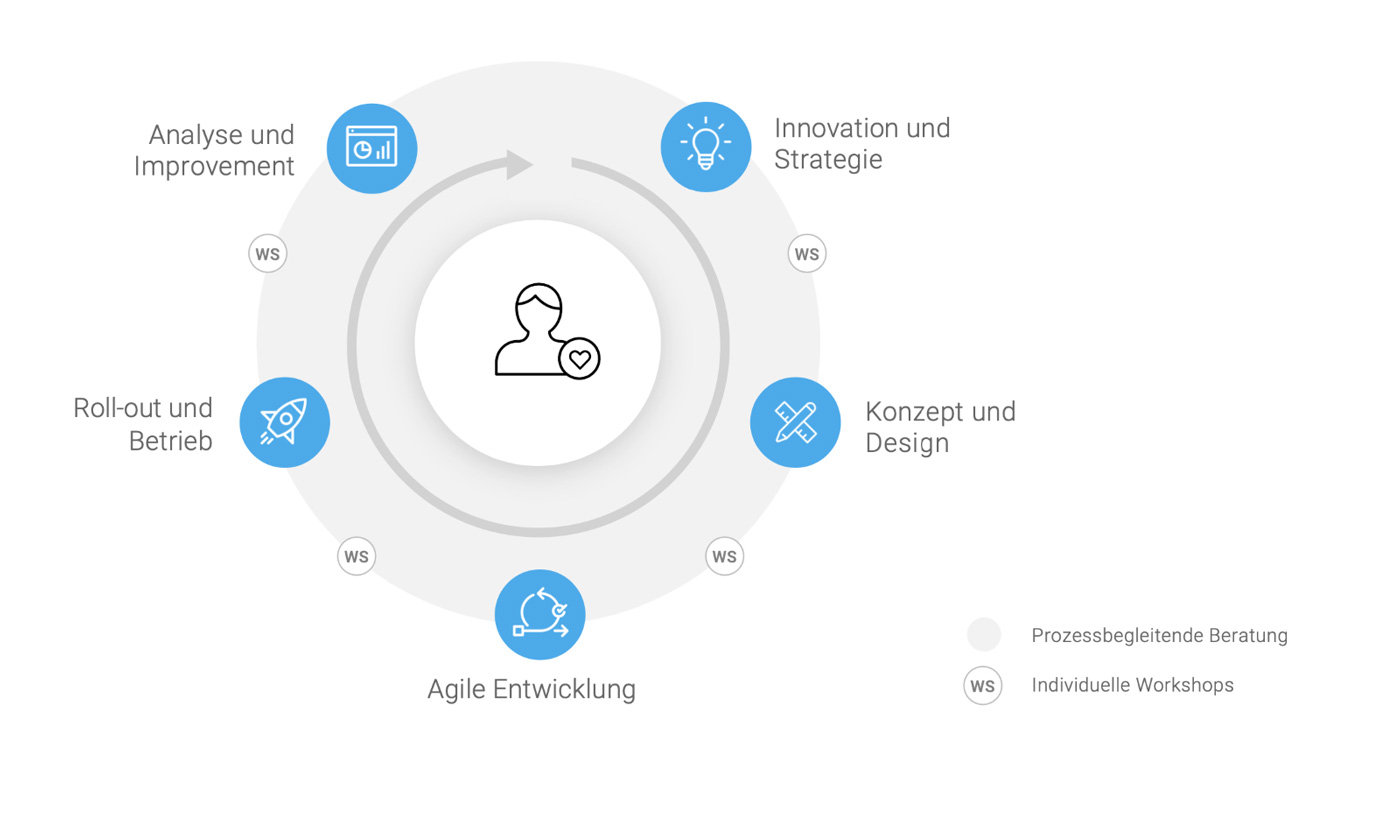
1 Analysis and strategy
We work closely with our customers in order to gain a precise understanding of current processes and the potential for digitalization. In workshops we talk to all stakeholders to clarify goals and needs. This information, along with technical analysis, is the basis on which we develop a strategy for your new processes and structures. We record the results for you in the form of Miro boards, process documentation and roadmaps. Software architects are involved in developing the strategy from the start. This early involvement leads to technical solutions that can be delivered efficiently and prevents your process knowledge from being lost later in the project.
2 Concept and design
In the next step we make the strategy concrete by producing mockups and high-fidelity designs of the planned software. We define the software architecture and the technology and build clickable prototypes so that you can run first tests. Detailed user stories and acceptance criteria help define the requirements clearly. We prepare a detailed proposal so that the customer can decide whether to commission us with the build.
3 Agile development
Custom software development runs agile in two-week sprints. Our customers have full visibility throughout, since we work in tools such as Jira and Confluence. Depending on what you prefer, you can take part in all or selected sessions such as dailies and sprint reviews. Through continuous testing and feedback from internal QA teams and from the customer, we make sure we meet your requirements and keep improving the result.
4 Rollout and operation
Once software development is complete, it is deployed either on our servers or on yours. We train your staff comprehensively in using the new solution and offer ongoing maintenance and technical support. That is how we make sure the software is integrated into your company to best effect.
5 Analysis and improvement
We also remain at your side after the core project is finished, if you need us: we analyse the new processes and the software in use regularly in order to identify potential for improvement. If we see a need to act, we make the improvements in agreement with you, so that the development process moves into its next iteration.
Standard software versus custom development: what suits when?
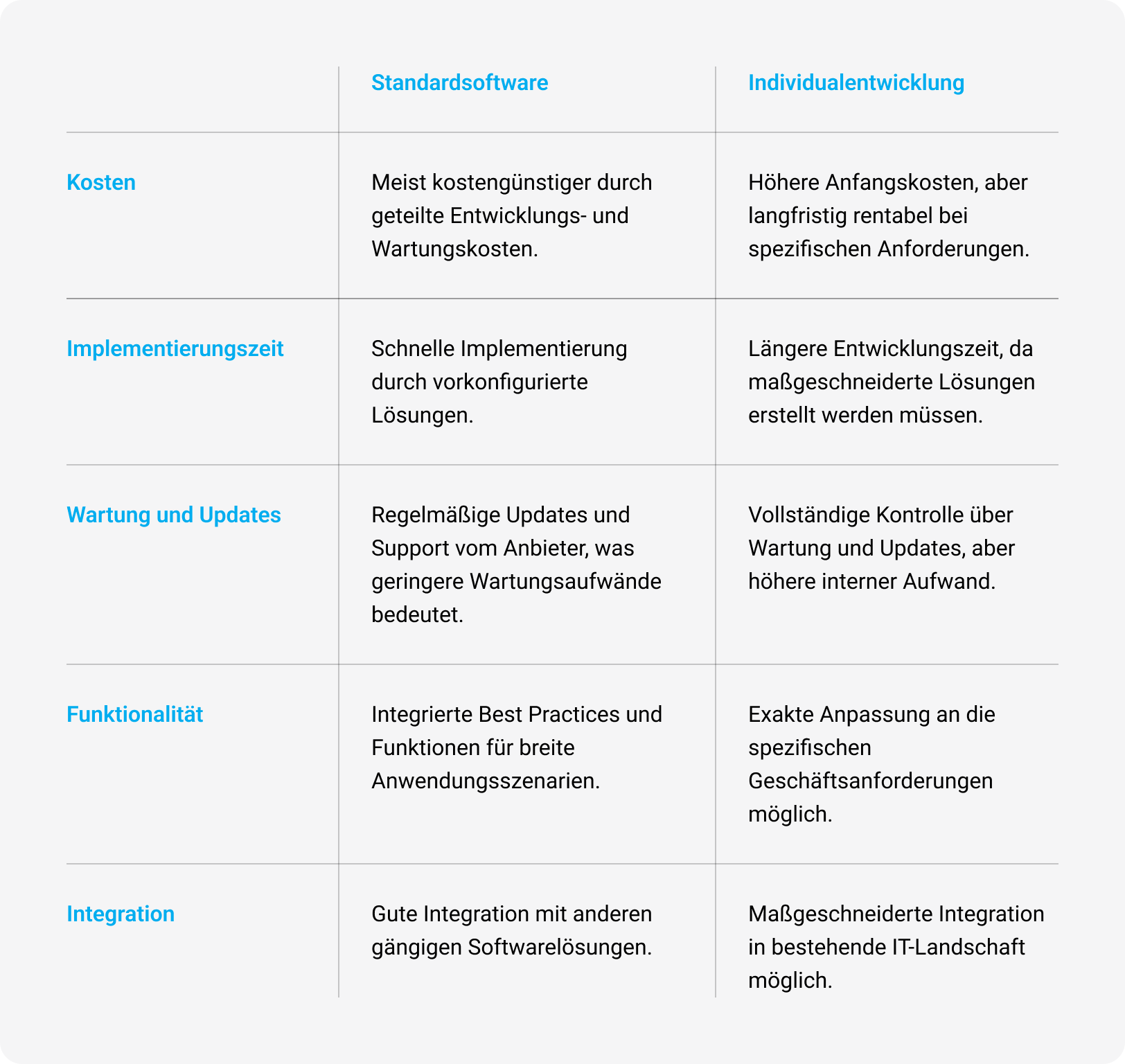
We often hear in customer conversations that people fear the high cost of process digitalization. There is a fundamental misunderstanding here: digitalizing processes is not inherently expensive. The cost depends heavily on how specific your requirements for the software are. Custom development plays a central role in this, since it is often the decisive cost factor. The good news for you: custom development is not always the best solution. Sometimes there are sensible standard solutions that we can adapt specifically in order to optimise costs.
The table shows you the advantages and disadvantages of standard software and custom software. The comparison cannot replace individual advice, of course. Not least because in some cases combined solutions are an option, where we adapt standard applications to suit the purpose. So do get in touch and we will work out together what a viable solution for your goal and your budget could look like.
Our 6 most common use cases: where process digitalization pays off most
Depending on the industry, there are some use cases that are particularly well suited to process digitalization, because experience shows they have a high economic impact. Sometimes all it takes is introducing new standard software or a manageable app. Sometimes a precisely fitting custom development is needed. And sometimes process digitalization makes the integration of entirely new digital products or digital structures necessary. We advise you with an open mind on which use case should be at the top of your agenda. In our experience, this is where treasure is most often buried:
- Self-service portals
Customer enquiries or orders used to be handled manually, which given the high workload on staff often took a long time and caused frustration among customers. By introducing a self-service portal, as at our customer Sodexo for example, you not only speed the processes up but also minimise the error rate through technical validation. Customers gain autonomy, their satisfaction increases: a clear win-win.
- Workflow automation
Many manual workflows in companies can be automated, so that results are achieved more efficiently, in better quality and at lower cost. With progress in AI in particular, your company can now delegate more demanding activities to machines as well. Our project experience with customers such as Axel Springer, OptoVision and Simpleshow confirms this: their staff have to spend considerably less time on routine tasks and have significantly more time available for value-creating work.
- Marketplace
Companies that broker services or products benefit enormously from introducing a digital marketplace. Our customer Mit uns Leben, Germany's largest ecumenical start-up, places care workers. We developed a care platform including an online shop, so that relatives can arrange professional care with considerably less effort. Marketplaces reduce transaction costs, improve transparency for users and, not least, digital platforms are easy to adapt, so that companies can respond to market changes more easily.
- Data capture
For fast, error-free data capture, digital solutions are a must. They prevent errors and reduce costs. They show their full effectiveness when they are integrated into well-thought-out end-to-end processes. A typical field of application is industry, with its maintenance and documentation obligations. But other sectors benefit too. At Médecins Sans Frontières, for example, we improved the capture of donations. The organization not only reduces its processing effort as a result, but can now analyse data in real time and derive valuable insight for its strategy.
- Document management
When managing digital documents, many companies struggle with decentralised systems that have grown over time. Searching for information takes effort, and misunderstandings easily arise from different document versions. Processing costs rise unnecessarily. With a digital document management system (DMS), like the one we built for Orgavision, you bring order to your organization: your documents are stored centrally and are easy to search. You avoid duplicates causing confusion. Instead you improve your compliance and significantly reduce your risks and costs in document management.
- Customer management
Customer information used to be managed on different platforms or even manually. That delayed the handling of orders, reduced the scope for comprehensive analysis and led to a poor customer experience, because different contacts were not working from the same information. We have already successfully integrated digital solutions such as CRM systems for customers including McFIT and Freiburger Nachrichten. These centralise all customer interactions and enable personalised, fast and efficient communication. That improves not only customer loyalty but internal processes too, since information is available immediately and consistently and can be used comprehensively.
Challenges that should not discourage you
There is a spirit of new beginnings in German companies. The willingness to transform is high, but more and more organizations are also sensing that the high expectations they placed on new technologies for efficiency and cost reduction are not being met. Gartner stresses that only 8% of boards take digitalization into account in their growth strategies, while 35% of them do reach the transformation goals they set.
To stop large investments leading to disappointing results, your company should get familiar with the pitfalls of transformation projects and take proactive measures so that these do not sabotage the success of your digitalization initiatives. We look at the biggest challenges and have tips on how to master them.
High costs
Process digitalization can involve high initial costs, particularly when the digital infrastructure has to be adapted. That is why it is so important to prioritise use cases and to start with ones that deliver a quick return on investment for a manageable outlay. The first measurable successes then encourage decision-makers to risk further investment.
Companies repeatedly find that the costs they planned turn out higher after all. What happened? They did not sufficiently account for hidden costs such as training, data migration and system integration. Remember too that you can use public funding programmes for digitalization or enter partnerships in order to reduce the investment costs.
Longer project timelines
People tend to underestimate the time needed to complete a task. For your project planning to work out, define what your first usable version of the digital process should look like. That helps you avoid scope creep and a project that keeps expanding. Work with agile methods in order to make fast progress through close coordination between developers and stakeholders. Evaluate your progress regularly and adjust your project plan in order to reach your result on time and on budget.
Missing expertise
Many companies do not have the internal expertise they need to digitalize processes successfully. Rely on external partners who have both technical and process knowledge and can support you with strategic planning and delivery. Where necessary, work in parallel on building your internal know-how, so that you do not become too dependent on service providers but can cover many tasks with your own staff over time. With complex systems in particular, a long-term partnership with an expert team can nevertheless be more cost-effective for outsourcing support and further development.
"Difficult" process steps
Legal assessment of documents, diagnosing illnesses: some procedures seem too complex to digitalize, let alone automate. With the help of modern technologies such as artificial intelligence and vector databases, though, reliable solutions can often be built. These can either automate the process step completely or prepare the information for a person so that the step can be carried out considerably faster. Get advice from specialists who can demonstrate industry experience, and explore your options.
Resistance from staff
The best digital solutions are of little use if staff do not make the most of their potential or if frequent errors affect efficiency. Acceptance of digitalization in your organization is a decisive factor in reaping the business benefits of the changes. According to McKinsey's Harry Robinson, a lack of employee involvement is a main reason why transformations fail. So start with internal communication early: point out how the new systems will improve your staff's working day, offer training on the new applications and create a culture that celebrates digital successes and motivates staff to take an active part in the further digital transformation themselves.
Conclusion: process digitalization as the basis for future viability
Process digitalization is a necessity today. If companies want to hold their own in competitive markets in future, they have to use its advantages for cost reduction, efficiency gains and customer satisfaction.
But digitalization comes with many challenges: digital structures that have grown over time, high initial investment and rising organizational complexity are holding many companies back from driving their process digitalization forward more decisively. This is where it pays to draw on advice and support from capable specialists. Because every further delay today means greater competitive disadvantage tomorrow.
Do not act hastily, but give your digital transformation priority. Digitalize step by step. Collect manageable use cases that promise quickly visible success, in order to minimise risks while building acceptance within the organization.
Since artificial intelligence has been finding its way into business processes more and more, the pressure to innovate has increased. Because digital processes are the basis for benefiting from these new technologies. Anyone who does not use them will fall behind in competition within a few years.
FAQ: frequently asked questions about process digitalization
1 What is process digitalization?
In process digitalization, existing analogue and often manual processes are transferred into digital systems. When large and mid-sized companies want to digitalize their processes, the most common goals are to increase efficiency, reduce errors and make data more usable. Since digital processes are easy to adapt, companies also gain flexibility and resilience: they can respond to market changes faster and more cost-efficiently.
2 What are digital processes?
Digital processes use modern technologies to make workflows more efficient. Where analogue processes once used pen and paper, working steps are now standardised with the help of software. Automation and artificial intelligence can minimise human intervention in the processes, which ensures consistently high processing quality and fast processing times.
3 How can I make sure my process digitalization succeeds?
If you want to digitalize processes, it is important to proceed methodically and with a plan. The more complex your use case, the more decisive detailed preparation becomes. We support your company with our best practice approach so that you do not make mistakes along the way. Before the project starts we check whether you need to improve workflows and implement new systems, so that your expectations of digitalization are actually met in the end. Because a poor analogue process cannot perform digitally either.
4 How long does it take to digitalize my process?
How long process digitalization takes depends on various factors: the complexity of the process, the number of people involved and the resources available. Simple processes can be digitalized within a few weeks; more complex projects often take months before they have found digital form. We run an analysis workshop with our customers in which we establish the status quo, the goals and the requirements and work out a first roadmap. After that we can put together a precise cost calculation. Would you like a first cost estimate in advance? In a no-obligation consultation we can give you a rough assessment based on our project experience.
5 What are the limits of digitalizing processes?
Full process digitalization is often technically feasible but not sensible everywhere. In some areas a human component is wanted, in customer service for example. Maximum automation would be counterproductive there, because it would lower the customer experience. Another limit is legal requirements and security concerns: digitalization must not become a business risk factor. And if staff do not make the most of the opportunities in the new digitalized processes, they likewise limit the economic effects.
6 Which technologies are particularly useful in process digitalization?
Key technologies for effective process digitalization are data analytics, artificial intelligence and the internet of things (IoT). Real-time processing of large volumes of data (big data) and the use of AI algorithms (AI consulting) make it possible to automate complex tasks as well. IoT technologies then also allow physical devices and machines to be integrated into digital processes and controlled autonomously.
7 How will the digitalization of important business processes develop in future?
The future belongs to data-based and highly automated processes. Machine learning and AI will prepare or take over many tasks, including complex ones. People will spend more time planning the strategic use of AI systems, training the applications and checking the results. We already support companies that want to digitalize processes in a way that achieves optimal collaboration between people and machines. Collaboration that is legally sound, values-based and value-creating.
8 What is the difference between digitalizing and automating?
Digitalization transfers analogue information into digital formats. The handling can still be done manually within digital systems. But digitalization creates the precondition for automation. With the help of various technologies, processes can then run without human intervention. For companies to get the greatest value out of digitalization, process digitalization and automation always have to go hand in hand.



Tech Newsletter
Join our 2,000+ subscribers and receive monthly updates on our latest articles, case studies, webinars, events, and industry news.